
Issue 34 | Spring 2026
Slingin’ Pearl
E verything was going according to plan until Sequoya had to take a shit. “Guys,” she radioed over to Jared and Cleo in the cruiser, “it’s a code brown. Cover me.”
They’d never agreed on a system of codes. It would’ve made no difference if they had. They wouldn’t have covered her. They hadn’t heard. Jared’s elbow had knocked the walkie-talkie’s volume knob a few minutes earlier, when he’d reached into the backseat for the cocaine.
“Is this really the best time for drugs?” Cleo had wondered aloud. She’d just rolled a joint and was smoking it, but weed wasn’t drugs. Weed was just weed. It was legal now, mostly, and anyway, they were the authorities. They were the ones with the cop car.
Jared had bought the car two months ago at a fundraising auction for twenty-two thousand dollars. “It was an impulse purchase,” he’d explained.
“Chewing gum,” Cleo had said, “is an impulse purchase.”
The Police Department had done their due diligence, removing the decals before putting the car up for auction, but what the Police Department hadn’t known was that Jared had a graffiti guy. Jared’s graffiti guy had happily graffitied the decals back on. Now Jared was as much a law enforcement officer as anyone who’d attended the academy. He had a real squad car. He had a real gun. He had a real-enough uniform, courtesy of Amazon. Tonight, he was lying in wait for real criminals, real sickos, real honest-to-God monsters. When the time came, he would show no mercy.
“These drugs,” he’d said, brandishing the baggie of powder, “are going to make us better at what we’re here to do.”
Cleo had sat in silence for a while, turning this thought over in her mind as if it were a Rubik’s Cube and she were a failed magician, or a talent show contestant surviving on pity, or a child who’d mixed up prodigy with prodigal—someone, in short, who ought to know how to solve Rubik’s Cubes, but didn’t. Smoke had eddied in front of their faces, disturbed by their breathing. There’d been just enough left of the day for the smoke to be visible, thick inside the car. Outside, beyond the sign announcing that a Super 8 was tucked away behind the trees, sodium floodlights had flickered on.
“I don’t know,” she’d said after a while. “I feel like it’s more about the principle of the thing.”
“What principle?” The way Jared had spat the words had made the strands of smoke cavort with greater urgency. “What principle of what thing?”
“We’re supposed to be alert,” she’d said. “For her. I mean, they’ve been in there for kind of a while. Don’t you think? If you think about it, she might be getting raped right now.”
“If you think about it,” Jared had said, “that’s basically an occupational hazard.”
“She’s such a sport,” Cleo had mused reverentially.
“We all do shit we don’t like for our jobs,” Jared had said. “It’s not like she’s the only one. I’m always up at four a.m., taking it up the ass from Dad. Metaphorically, I mean, but sometimes that’s worse than literally.”
“Are we bad people?” Cleo had asked. “Are we human traffickers now?”
“Absolutely not.” Jared’s knuckles had cracked like gunshots, their reports barely softened by the layers of smog. “We’re the ones busting the human traffickers.”
“Hold up a minute.” Sobering, Cleo had peered through the windshield. “What’s that?”
Backlit against the afterglow of vanished sun, a silhouette was coming toward them, bobbing along the shoulder of the exit ramp. Jared’s hand wafted toward his holster like a helicopter pod.
“Don’t shoot.” Cleo gripped his arm. “It’s Sequoya.”
“What the fuck, guys?” Sequoya hammered on the passenger window. “Why aren’t you answering?”
“Why are you here?” hissed Cleo. “Why aren’t you watching the hotel?”
“I told you, I had to take a shit.” Sequoya was pale and spectral in the gloaming, her acne worse, her cheekbones starker. Her curly hair billowed from her scalp asymmetrically, mauve and chartreuse, trimmed like a bush by the side of a road that saw a lot of tractor-trailers: the work of her own hand. She leaned into the squad car, elbows folded on the rolled-down window. “Weren’t you covering me?”
“How could we cover you?” demanded Jared. “How could we cover you from all the way over here?”
“Shit.”
“Don’t panic.” Cleo could feel the murky turbulence receding, leaving her mind as loose and empty as a plastic bag. “It was just a few minutes,” she said. “I’m sure nothing’s happened. I’m sure they’re still in there. I’m sure she’s fine.”
“You don’t know that.” Sequoya spun away from the car like a music box doll, bell-bottom overalls flaring, fingers crawling into her hair like frightened millipedes. “You don’t know.”
“No one came out this way,” Cleo said. At least she didn’t think so. She was pretty sure. The smoke’s fingers were probing her eyeballs, tugging gently at her optic nerves.
“But there’s the other road,” Sequoya said. “They could’ve gone that way.”
“Well?” Jared was fiddling with his walkie-talkie. “What are you just standing there for? Go and scope it out, why don’t you?”
“We’ll make it legit as hell.” Pearl’s voice in Cleo’s ears: manic, exhilarated, textured with vocal fry, that sweetly sandpapery trill. “We’ll troll these guys so fucking hard. We’ll beat them at their own game.”
“She was such a sport,” Cleo murmured, self-echoing, not meaning the past tense: the was just snuck in. She hadn’t even left this time. She’d barely even thought of leaving. The shape of Sequoya was dwindling into the darkness, a blossom sinking in a pond. Jared’s knuckles were already cracked, but he was still working on them, wringing and twisting.
“How much do you think we could get for me?” On the sofa, swaddled in her moldering throws, Pearl had looked like a porcelain doll, arms wrapped around her knees. “I feel like I’m worth at least a hundred grand.”
She’d practically lived on that sofa—again with the past tense?—eating there, working there, fucking there, sleeping there, snoring for thirteen-hour stretches in between code sprints with skunk-scented drool seeping into her hair. Her looks had nearly made up for the fact that she’d rarely showered—at least the folks on Kink.com had thought so. She’d been so possessive of the sofa, and so comparatively unattached to everything else she owned, that Jared and Cleo had been talking about putting her room up for rent again, advertising it as fully furnished this time.
“I’ve just been thinking,” she’d gone on, “there’s some software I’m really going to need if I’m going to do that Belarusian nuclear facility.” Pearl belonged to a globally distributed digital gang and spent her days hacking into government databases and selling state secrets, whenever she wasn’t hosting orgies, or ordering meatball sandwiches on DoorDash, or sleeping. If not technically a savant, Cleo had long since surmised, Pearl was at least savant adjacent. “They’re not cheap,” she’d continued. “And drugs aren’t cheap. And DoorDash isn’t fucking cheap these days. This economy is really pushing me to think outside the box. Anyway, a hundred grand, right? Minimum?”
“It depends.” Sequoya had been on the floor, crisscross applesauce, furiously finger-painting the splintered half of a white-pine board that she’d been given by one of her johns, a Shuri Ryu instructor, as a token of his regard. “Are we allowed to haggle?”
“Hell fucking yes, you’re allowed to haggle!” Pearl’s fist had winded a throw pillow, releasing a puff of dust. “This isn’t Target we’re talking about here. This is the dark web. It’s like an old-world souk. Like you’d find on the streets of Morocco. You’re expected to haggle.”
“That’s why they call it the Silk Road,” Cleo had chimed in from the kitchen. It had been early April, the house long overdue for its annual deep clean. The sharp-cornered objects she’d already purged protruded through a tattered garbage bag: a broken umbrella that someone had hung from the ceiling, a jug of moonshine that had been discreetly fermenting under the sink for six months, and an urn that contained someone’s ashes. No one was sure whose.
“I’ll write your profile,” Sequoya had volunteered. “It’s my area of expertise.”
“Okay,” Pearl had agreed. “But remember, this isn’t Tinder we’re talking about here. This is a grungy meat market on the dark web. For all intents and purposes, I am an object. A commodity. Not the sophisticated lady who you know and love, who containeth multitudes.”
“You don’t have to say ‘containeth,’” Cleo had said. “That’s just for the Bible and Shakespeare. Not Whitman.”
“Same thing.”
“Has anyone changed the AC filters in here?” Cleo had wanted to know. “Recently? Or ever?”
Blank faces. Dead-eyed stares. “I think my dad does that,” Pearl had said. Her father stopped by once a month or so, just in case anything material in his daughter’s life needed fixing.
“No, honey. Your dad does not do that.” Leaving the dismembered garbage bag in the kitchen, Cleo had headed for the closet where she kept the fresh filters. “Move, bitch.” She’d given Pearl a prod with her toe. “Get out the way.”
“Here’s the plan.” Pearl had scooched aside obediently, making space for Cleo to reach the vent above the sofa. “We’ll have a drop point. Some shitty motel. When we get there, I’ll be passed out drunk and shit, like basically incapacitated, and you guys will hand me over like I’m your property, right, like not even a human being. But what those motherfuckers won’t know is that one of you will be in the parking lot the whole time, undercover, and as soon as they try to whisk me off to some second location, you’ll sound the alarm, and Jared will roll up in his cop car and arrest the shit out of them.”
“That,” Sequoya had said, “is a fucking brilliant plan.”
“You said it was going to be easy.” Jared’s voice tore through Cleo’s reverie, shredding the Pearl in her mind, sharp corners through a garbage bag. “You said you’d thought of everything.”
“We thought we had.” Something in Cleo was curdling, turned by the shrug in her own voice, so light, so blasé. “We thought of what we thought of. You could’ve thought of things, too, you know. You never said anything.”
“I was fucking exhausted,” said Jared. “I work eighteen-hour days. Besides, you sounded like you had it all under control. I wasn’t going to be the guy who’s like, Hey, you girls don’t know what you’re doing. I’m taking charge.”
“If you don’t want to be here,” said Cleo, “then maybe you shouldn’t be. Maybe you should give back your share.”
“It’s not like I’m even keeping it.”
“None of us is keeping it,” said Cleo. “That’s not what you do with money. You don’t keep it. You spend it on shit that makes you feel good.”
“You think giving it to Dad is going to make me feel good?”
“You’re not giving it to Dad,” said Cleo. “You’re giving it to you. And Dad’s going to make you feel like shit no matter what you do.”
Sequoya’s voice came crackling through the walkie-talkie: “She’s not here. The car’s gone. I went to their room, I was knocking—”
“Jesus.” Cleo drew herself up straighter. “You’re going to get yourself killed.” The line went vinyl-scratchy: Sequoya hyperventilating. “She’s having a panic attack,” Cleo said.
“Shit.” Jared put the car in gear. “Let’s get her out of there.”
Sequoya was squatting by the stairs when they pulled in, her head between her knees. Her hair was bobbing as if in a current, a tremendous anemone, her whole body rocking. Moth-shadows danced on the asphalt, pixelating the parking spaces.
“Come on.” Leading her gently-firmly by the arm, Cleo guided Sequoya toward the squad car. “You’re okay. Breathe.”
“We’ve got to regroup,” said Jared. “We’ve got to make a new plan.”
Sequoya allowed herself to be folded into the backseat. Then she began to scream.
“That’s not helping,” Jared said. “Would you shut her up, please?”
Cleo tried to wrap herself around Sequoya, tried to straitjacket her with her body, but Sequoya would not be contained. She pulled her knees into her chest and started kicking the back of the driver’s seat, wordlessly howling.
“Look,” Cleo droned into her ear, too soft, too calm—dissociating? “Look around. We’re in a cop car. See? We’re under arrest. We’re being punished. We’re going to be fine.”
She hadn’t even left this time, had barely even thought of leaving, but sure enough the snap-back from the universe had come: just like how, as you get older, certain foods and drinks and drugs begin to take their toll. She could barely even do a line these days, or drink a Coke, or eat a pack of Oreos. Her heart was always almost stopping. She couldn’t say she hadn’t thought about it, couldn’t say the thought had not been tantalizing—not of going back to school so much as having gone, of having gotten a degree, a really good one this time, maybe even a PhD—but she wasn’t sure if it was what she wanted, really. She had her associate’s, more education than anyone else in the house, but teaching English online every night, she still made less than any of them. Less than Pearl and her digital gang. Less than Sequoya, who brought johns from all over the Arkansas River Valley—“serving underserved populations,” in her parlance. Less than Jared, who worked eighty hours a week with his father, Cleo’s stepfather, and commuted ten more because even after going into business with him, he still couldn’t stand to live anywhere near him. Jared’s only job before the sausage shop had been an ill-fated gig mowing lawns, but this didn’t stop his old man, who had a restaurant and a television show, from riding his ass about having contributed less than 50 percent of their startup capital. Jared would invest his cut from selling Pearl, Cleo figured, and nothing would change.
The red and yellow Denny’s sign above the parking lot that Jared swung them into was a knife between the ribs, a twisting. He was doing this on purpose, Cleo knew. Sequoya was silent, a tight little ball. No one was parked in the handicap space. Jared took it. He always took it, even when he didn’t have his decal with him, even though he hardly even limped anymore. Watching him march them inside, no one would’ve guessed that his left foot was plastic.
He sat them down and slid into the booth across from them, his uniform raising a squeak from the Naugahyde. The hide of the Nog, he’d told Cleo once, long ago, he and his father two new constellations rising in her sky. And eggnog was made from the eggs of the Nog. You had to use every part of the Nog. He ordered pie, two slices: chocolate and pecan. He sat with his fists on the Formica, clenching and unclenching. “If you think about it,” he said, “we get bigger cuts now.”
Cleo watched their doubles in the windowpane: Sequoya, pale and trembling; Jared, lobster-faced with popping veins; and her, moony, with a blank expression, strangely calm.
“Whatever.” Sequoya wiped her nose with the back of her hand. “I’m not even keeping mine.”
“None of us is,” said Jared. “That’s not what you do with money. At least I’m investing mine. You’re just going to go and give yours to those queers.”
“Fuck you, homophobe.”
“I might be a homophobe,” said Jared, “but I’m not the misogynist here. I’m not the one who wants to beat chicks black and blue.”
Black and blue. That was what Sequoya had said the night she’d gotten shitfaced in the gay bar where she’d used to sleep when she’d been homeless, in front of the owner and patrons: that she only wanted to be a man so she could beat chicks black and blue with her dick while she fucked them. That was what chicks deserved, all of them, starting with her mother, who’d left her and her sisters alone in a barn, and that was how she’d learned to start fires, and trap rodents, and spit-roast them, and their mother hadn’t even come back for them, it had been the authorities who’d finally recovered them, and they’d ended up in foster care, but none of the foster moms had been decent either, if they had, she wouldn’t have run away so many times, and the moral of the story was that bitches ain’t shit. That had been her last night in the gay bar. Ever since, she’d been donating everything she’d made, hoping they would like her again. But they were not going to like her again.
“Fuck you.” She glared at Jared sullenly from red-rimmed eyes. “You’re the one we should’ve sold.”
The pies came. The waitress placed one in front of Sequoya, one in front of Cleo. Cleo knew she was watching her whether she seemed to be watching or not. And the guy behind the counter—he was also watching. And her own reflection in the window, also watching. They were all watching. They’d all been watching for a long time. Since she’d been a little girl. They all knew how selfish she was.
“You told me it was going to be easy,” said Jared. “You said you’d thought of everything. I work eighteen-hour days. You three just sit around like bums all the time, ramming your fucking dicks into the ground. How come one of you didn’t think of a better plan?”
On the far side of the diner, a mother grabbed her toddler’s arm. The waitress bringing her the check was surreptitiously tracking Cleo. The toddler watched unabashedly, round-faced and saucer-eyed.
“We’re going to get kicked out,” Cleo murmured.
“I’m a cop,” Jared said. “Cops don’t get kicked out.”
Sequoya grabbed a crayon, a green one, and started scribbling on the brown paper place setting. Crooked lines. Polygraph-style.
“I can’t deal with this right now.” Cleo stood. “I’m too sober.” The lights were too bright, the clink of forks too loud. Her nervous system jingle-jangled with the bells. The cruiser winky-blinked, a summons. In the diner window, Jared tipped his head: you’re welcome.
Cleo sat with the door open, feet on the running board, Pearl’s boneless weight across her shoulders, heavy as a sack of grain. “We’re really doing it.” Pearl’s voice close to her ear, fried and slurring. “We’re selling me. We’re selling Pearl. This is pretty sick, man. Check it out: we’re slingin’ Pearl!” Then she was retching. Her saliva gleamed orange in the glow from the sign. The words meat market clattered in her brain. They’d used Jared’s van—not unmarked, not with the sunglass-clad sausages that his graffiti guy had done, but the closest to an unmarked van they had. The man who’d met her had reminded her of Jared’s father: stocky, mustachioed.
“It’s me,” she’d said stupidly. “We’ve been texting.”
He’d stared at her with empty eyes. Relentless eyes. His having agreed to her terms and conditions and even the proposed point of rendezvous had bolstered her confidence somewhat. His not supplying her with a receipt, less so.
She still had the Signal thread. She could still message him. But what would she say?
The Denny’s watched her with its huge, incandescent, rectangular eyes.
You’ve got the wrong girl, she typed. Then she deleted it. Then she typed it again and hit send. The night was alive. She could hear every insect for miles. She took a pull. How would you like to get 25 percent back?
Money was the language they would understand. Money and fear. Money and fear and power over—but maybe she was merely sending words into the void. Self-soothing. Texting a burner phone. Was this any different than prayer?
I don’t know if you’ve figured it out yet, she typed, but you better hear me out unless you want to end up with your dicks bitten off. That’s Pearl when you make her mad.
In the diner window, Jared and Sequoya were two soundless puppets pantomiming rage.
Me, she typed, I’m not that kind of girl.
Was she a girl still? At thirty? Almost thirty-one? When did you become a woman, anyway? When you learned how to change AC filters?
I’m so tired, she went on. I don’t want to do this anymore. I’ll do pretty much whatever you want me to do. I’m your dream girl, basically. And I’m 25 percent off.
She felt like an actress whispering sultry secrets in a stranger’s ear. She felt like a woman coquettishly playing a girl—better than being a girl who was playing a woman, though she knew her lines too well.
She hit send.
She typed, I’m so tired of being the reason when something bad happens.
She took another pull. The words quivered under her nose like miraculously complex microorganisms. Living things.
She continued, First it was Mom. It didn’t matter how much she was working, or who she was sleeping with, or how little money there was. She always made time. We’d go to Denny’s, me and her, every Saturday morning. That was our thing. At least until I started middle school. I just up and told her one day that I didn’t want to do it anymore. I wanted to hang with my friends instead. We were all into Magic: The Gathering. I basically dumped her. Then she got cancer. Colon cancer.
She felt as if she were confiding in a diary. As if she were whispering secrets to an imaginary friend.
Then Dad, she continued. I never wanted to visit him anymore, so one night he dropped his phone in the bathtub. Almost died. Third-degree burns. Then I was like, you know what? Fuck it. Fuck this whole family. I’m out. They’re on their own. I was always staying with friends during high school, I was pretty much never home, so then my sister tried the cinnamon challenge with nutmeg and died of myristicin poisoning. Then my stepbrother ran over his foot with a lawnmower. Then Mom died. Then Dad shot himself. I’m not going to try to run away from you, is what I’m saying. I’m so fucking tired of running. I’m so fucking tired of blowing up everything every single time I try to run. I won’t give you any trouble. You’ll never have to lock me up or anything. I’ll be the easiest girl you’ve ever had.
She stopped typing. The insects, she realized, were really just silence, that cacophonous silence that only sets in when you’re completely alone in the dark, in Antarctica, and even the wind has died. Through the diner windows, the waitress was watching, and the guy behind the counter, and the mom with her toddler, and Jared, and Sequoya, all of them were watching, all those imaginary friends with their imaginary faces flat against the panes. History was watching, whatever that meant. God was watching. The NSA was watching.
She closed her eyes. She couldn’t do it. She knew herself. She wasn’t brave. She might never run, but sooner or later, she would think about running, and running and thinking of running, she knew now, were one and the same.
She selected her confession. In an instant, it was gone—and there, in the thread where it had been, beneath the last text that she’d sent, 25 percent off, were two words:
I’m listening.
About the Author
Itto and Mekiya Outini write about America, Morocco, and all those caught in between. They’ve published in The North American Review, Modern Literature, Fourth Genre, The Good River Review, MQR, Hobart, Lunch Ticket, The New English Review, CommuterLit, Chautauqua, Mount Hope, Jewish Life, The Stonecoast Review, The Brussels Review, New Contrast, Eunoia Review, ExPat Press, Lotus-Eater, Afritondo, Gargoyle Magazine, and elsewhere. Their work has received support from the MacDowell Foundation, the Steinbeck Fellowship Program, the Edward F. Albee Foundation, the New York Mills Cultural Center, and the Fulbright Program. They’re collaborating on several books, running The DateKeepers, an author support platform, and co-hosting the podcast Let’s Have a Renaissance.
Prose
Slingin’ Pearl
Itto and Mekiya Outini
In Heaven Everything is Fine
Grant Maierhofer
My Priest Predicted I’d Be a Spy
Garima Chhikara
Poor Thing
Claire Salvato
Hot Tub Paul Hollywood
Garth Robinson
Montara
James Nulick
Two Millimeters In
Jade Kleiner
Little White Monkeys
Manshuk Kali, translated by Slava Faybysh
To Understand Light
Ricardo Bernhard
Apartment 304
Rowan MacDonald
Properly Dark
L.M. Moore
Poetry
witness to the non-arrival
with history trapped inside us
Stacey C. Johnson
New in Town
Alex Dodt
After the Simulation Learns to Listen
David Anson Lee
Missiles Like Low Ceilings
Will Falk
The Sigh of a Man
Davey Long
Abduction III
Jo Ann Clark
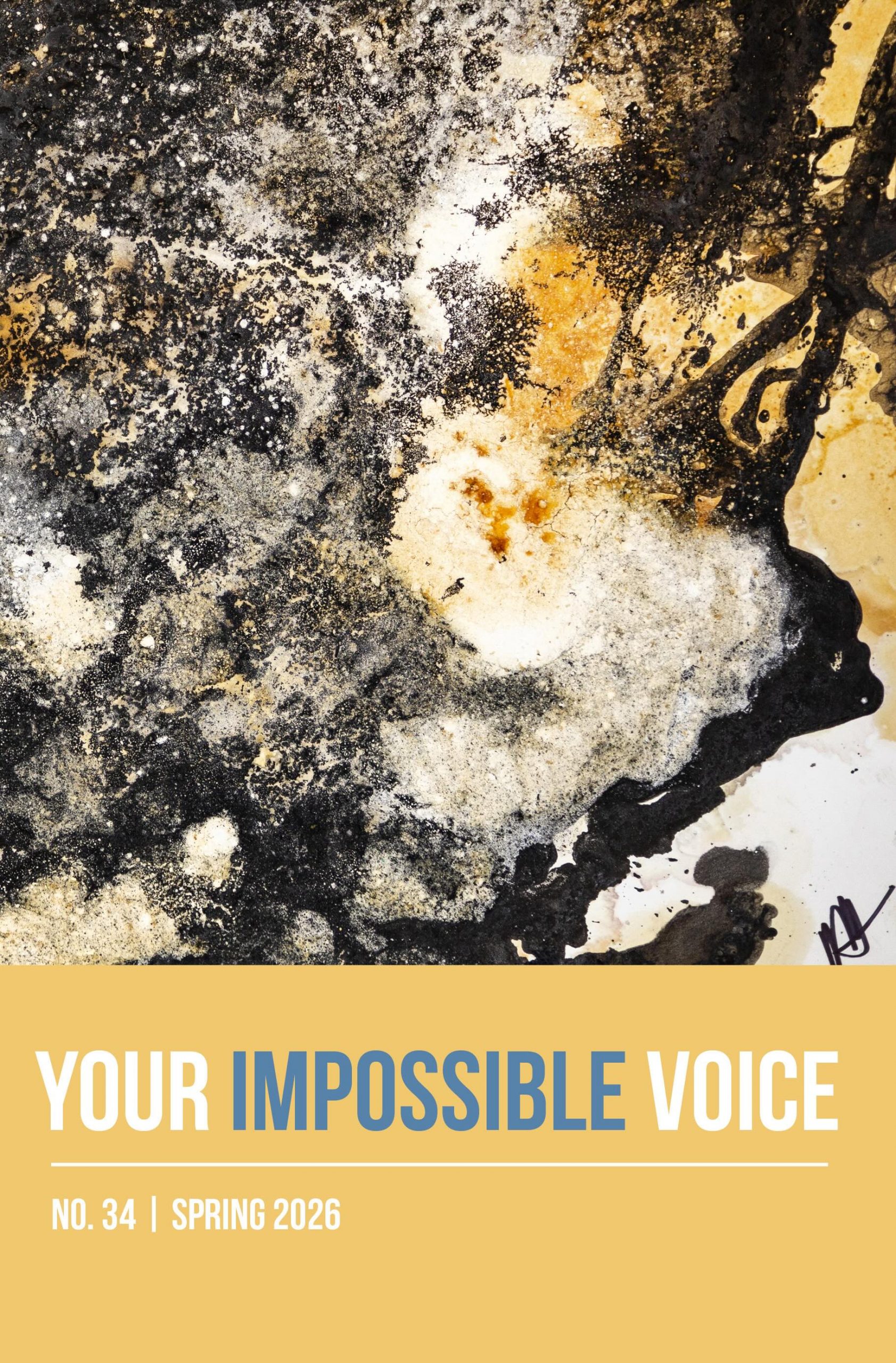
Cover Art
IMG6255
Richard Hanus