
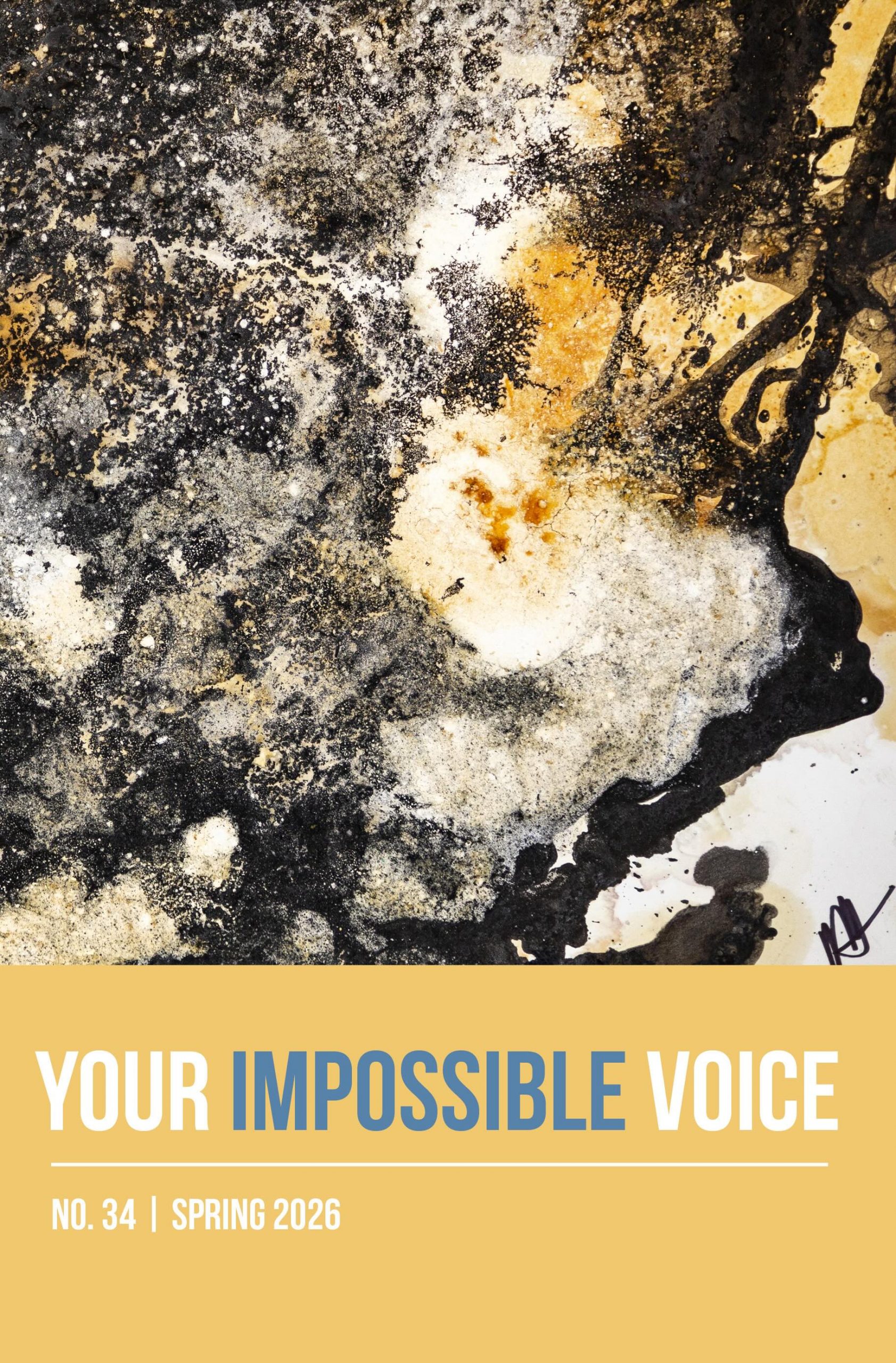
Issue 34 | Spring 2026
Poor Thing
I ’d begun practicing feeling the way I wanted to.
Last night, I dreamt I was standing in front of an open landscape composed entirely of garbage: cellophane tubes, striped straws, metal braces, cobalt magnets, lithium batteries, soup cans, plastic bags, leather fabric, frosted wine bottles, apple cores, dryer sheets, lint fibers. All of it piling up and up, springing out of the Earth like tuberous roots, blooming like megaflora. I listened to the soft hiss of my breath as I tried shoving all the air out of my lungs. I stood at the edge of a cliff in my dressing gown, clinging to my white fleece like it was going to pacify me.
I wasn’t angry. I remember feeling tired and nauseous and sick with grief—the way you get when you know something has to come out of you, like when something inside of you wants to go.
We start hanging around the house together every Sunday. I sneak him in through the back window inside the old maid’s room. When he cuts a sliver of his ankle against a loose screw on the hinge, I trace the sharp red line with my index finger and remember my grandmother’s shrieks, my father’s fist against the sullen girl’s neck. Through the tinted window, I see the maid lifting a plastic spoon to her mouth, resting her head against the wall, wondering how much air she can fit into her lungs while the lift is stuck to the ledge, how much a blower fan costs. I imagine her snagging our med-aid kit at midnight, pressing a bisque Band-Aid over her bleeding ankle until the blood dries up. She takes pennies out of my mother’s purse, wraps a floral scarf around her neck and lowers her eyes as she walks into the Best Buy, ordering the staff: “I’ll have that fan, please.” Then, I imagine she falls asleep face forward on the mattress listening to Marvin Gaye sing about freedom.
This is the room where he and I have sex for the first time.
We leave the door open, the window open. When it’s finished, he sings all the lyrics to “Kiss You All Over” as he traces the small of my back. I imagine the sound of his voice carrying from the window into the backyard of my neighbor. Their toddler learns to maneuver the rigid driving of training wheels as he hears the chorus. The hairs on his arm rise as he jolts over a rock, his speed doubling once the wind picks up, blowing the wheels of his bicycle as he propels forward, charging against the current.
We usually spend the rest of the day walking to get ice cream. He practices dipping his spoon into my Styrofoam cup over and over again, saying mine tastes better. I want to skip this part so we can have sex again later, but eat as much as I want because I like the way it feels to be full, and I’d only just started to like feeling full. I figured this was the one life I had—in it, I could be fed, unlike so many who’d starved before me.
We like taking long walks around the neighborhood. We like stopping at Ruby the dog’s house, petting and kissing the St. Bernard I once held in the palm of my hand when she was a puppy. We pet and kiss that dog without the owner’s permission, because we know that since last year, she has only grown frail and weak like the old woman who raised her. Still, she comes to lick my fingers, barking when we go.
Sometimes, we enter pet stores and watch terrapins resting on each other’s backs, observing the way they glare up into the amber of the artificial lamp light. We dance to reggae in frozen food aisles and play New Wave in car parks. We make out in elevators. I wear his clothes.
We practice asking each other what we want. We practice being kind to one another.
One night, while we’re walking home together in the dark, a deer and its fawn cross our path. “Careful,” he says.
The fawn’s eyes are angled at a slant. Suddenly, I get the feeling that I want to be all alone, that he shouldn’t even be next to me right now, asking me to be careful. When the two meet our eyes, they bolt. I don’t think there’s anything more beautiful than that.
My mother has to replace her tennis racket. A friend of hers from high school opened a dim sum restaurant several years ago. She says she’ll bring us there for dinner after she asks if her old tennis coach will wrap and seal a new handle for her.
“I was supposed to check it out a long time ago,” she said. “I forgot.”
We turn into a cul-de-sac after passing the public library. The sun is falling.
The coach’s house looks like a barn. He’s sweating through his shirt when we enter. He pats my mother on the back and asks if I want water or something else to drink. The boxed drinks come with little white straws and I can tell they’re lukewarm since they’ve been sitting under the hot sun. I say I’m fine without either and look up at his collection on the walls of his shed. Fine strings of blue, red, white, green, purple, and black. Moisture-wicking shirts, transparent visors, neon wristbands. Rolls and rolls of grip tape. Shuttlecocks, tennis balls. Shoelaces, shoes with cleats, shoes with gel-soles.
When we’d play singles, my mother used to holler across from the other side of the net, reminding me to bend my knees. You need to use your backhand to return low balls if you want to stay in control, or else the serve won’t turn out right, and your partner will always have an advantage.
After the coach bids us goodbye, the dim sum restaurant takes us into their waiting area. First, they keep us inside, and then they put us outside in the drizzling rain. I don’t see a word of English on the laminated menu, and my mother only half understands what the waiter means when he asks “with dry” or “with feeling?”
The dish that arrives smells like fried fish, but the colors on the plate are red and orange. I pick slowly at the plate, wondering if I can get something else later.
I think we start eating at restaurants like these because we’re supposed to start saving. My mother usually doesn’t have time to make food at home, ever since she started working full-time. On some days, she doesn’t even ask if I need to eat. We use coupons wherever we go. At checkout lines, we ask for discounts and freebies from old friends of store owners and clerks.
We never ask my father for cash. We’re okay without his money.
I ask if this friend of my mother’s sang in the church choir.
“She did, and she had a beautiful voice,” she says. “She had good posture, too.”
As I’m reaching for my phone on the other side of the table, my cup topples, spilling lemon tea all over the table. I scramble to wipe it off with the bottom of my shirt, exposing the lower half of my stomach.
“I would have put you in Catholic school, too. If I’d known the way you’d turn out,” she says, winking with a wry smile. “I should have convinced your father.”
“You never put posters on your wall?”
“I never liked anything that much to buy a poster of it,” I tell him.
Everything about my bedroom is bland. The sheets are blue. There’s no carpet. The curtains hang like long ghosts, blanketing nearly every inch of the wall. A few nights before my eleventh birthday, I caught a glimpse of our backdoor neighbor, a fatherless man who still lived with his sister, standing by the foot of his window, watching me undress. I explain that after that moment, my bedroom would no longer see sunlight—not for spring, not even for the stars at night.
“You seem like the kind of girl who’d be casual about something like that.” “Maybe,” I say.
I think for a second about whether I am the kind of girl who is unafraid of taking off her clothes in front of strangers. It occurred to me that if you didn’t care about strangers, you might be able to parade your naked body. If all anyone did was look, then there wasn’t any harm in being frivolous. But I didn’t even like taking my clothes off in front of myself. Each time I thought I’d lost weight, I’d find little pockets and sections of blubber hiding in unexpected areas. Each time I shaved, there was always a patch of hair that I missed. If anything ever did go away, it never left for good—you’d eventually find it reappearing where it belonged.
There’s a picture of my dad that sits next to a chest box of jewelry on top of a dresser. He’s unzipping his raincoat underneath the Grotto of Massabielle, lifting his hands up to receive the holy water from the well. My grandmother is hard to spot, but if you try hard, you can see her posing in the back. Her hair is still brown, and she’s got one hand on her hip as she smiles at the camera flash.
I keep his goodbye letter in the drawer under my sink next to a cluster of pure essential oil vials and a spare bottle of shampoo. Months ago, I’d been sleeping next to it, reading it in my bed every night like I used to pray before I got out of bed every morning. Gradually, I stopped. I was glad that my hostility towards him came naturally, that I didn’t have to force myself to quit thinking about his absence. The court psychologist mentioned that separation might feel a bit like a hangover, and that since everything in our lives relates back to our parents, the hangover would likely extend well into our adult lives and enable itself in subtle, treacherous ways. When she said this, I imagined an elastic string knotted around a tooth, attached to the lever of a doorknob—the door keeps opening and closing, but the tooth refuses to detach, and it just wiggles in its spot after each yank.
There’s an Alanis Morissette song about a woman who wants to have this man’s baby—she says “I’m not gonna fade as soon as you close your eyes,” and sings the “close your eyes” part so aggressively that when you hear it for the first time, you think to yourself: What would I give to make someone think of me. It’s a bit like this one part of my father’s letter where he starts talking about his mother’s smell—how whenever he misses her, he tries to picture her black shawl and sniff out her lavender perfume. I think he was trying to get me to miss him, but I don’t remember his smell. Now, I only take the letter out when I’m waiting for my nail polish to dry or for the bath water to fill the tub all the way.
My period doesn’t come by Christmas: I’m four weeks late.
The clouds outside promise rain. He says he can smell it in the air like he knows whenever shit is about to hit the fan, like he can smell garbage, trash stinking up the back of the house. While he watches me from the window seat, I say that when we have time, I’ll take him to the bakery I used to steal finger buns from, where my obsession with sugar was born, where I’d sneak off to from tennis practice when I was eight.
I thought that rain smelled a bit like air conditioning. The faint droplets of water leaking from the old yellow box—I thought they resembled tears. Insulated from thunderous storms, tears streaming down walls in silence, staining eggshell paint.
We get a plastic one for the living room. One with painted sticks for leaves and a charcoal metal pole for a trunk. My mother pays forty dollars for it at the checkout and asks if the discount for teachers still runs through the end of the year. We get a boneless turkey and a carton of eggnog for half off at Kroger. I pick out a health magazine to read at home for ninety cents.
The paint on all of our old ornaments is starting to peel off and smudge the bottoms of cardboard boxes with bleak bursts of glittering silver and gold. The wool stuffing Mother Ginger is stringing apart, seam by seam. One of Clara’s eyes has gone missing. One of the fountains inside a snow globe of Milwaukee has toppled over on its side, so the last two standing buildings form the shape of a V. Our golden star is missing an edge. We think it might have fallen off sometime last year when an ice dam fell through the roof, killing two robins and a sparrow, leaving a splotch of carmine blood on the patio.
I start thinking back to the winter ballet as I’m untangling LED lights, the fading snow on the front steps of the city hall, the cream and wool coats, the black and green embroidery on my velvet dress, the re-enactment of the nativity, my father singing “Amazing Grace” from the front seat, my grandmother applying rouge in the little girls’ room, her little white cat coming to sleep in my bed the night before Christmas morning.
When we’ve finished assembling all the parts, we circle around its perimeter and ask if we’ve done a good job. When we look at it up close, it seems like the whole thing might collapse then and there, like a leaning tower or a hanging bridge. But when we stand and look at it from afar, the job we’ve done seems perfectly fine, as though none of us did any of the work at all, like we had someone deliver it to our house in a boxed package.
“It’s a mess,” I conclude. “A mess to be thankful for.”
We take a break before we make the stuffing. I listen to Adele in the living room and draw circles in an empty notebook, waiting until I can nibble on bread cubes.
“Angela had a baby,” my mother yells from the kitchen. “I’ll send you the link.”
I always believed Angela left us because she was going to be a mother. I believed that she lied to my mother when she said her father was sick and that she wanted to help him battle his cancer. Certainly, I thought she’d been lying about something—my best guess was that she got knocked up. But her father really was sick, and she never came back. I remember helping to clean out the items in her room, detaching the sheer curtains from the hooks on the ceiling. I also helped organize her collection of model ships, arranging them neatly in a small box, driving to the post office to ship them out.
We were invited to attend her father’s funeral in Cleveland. I got to stand in line in my little black dress and look at the powdered face inside his coffin before they closed it forever. When the procession was over, I hugged Angela around the waist because she wouldn’t stop crying. My father turned his face when we bid our farewells. I remember my mother trying to get him to say goodbye, but he hid in the accessible restroom, claiming he had an upset stomach.
“She was such a good fit,” my mother says. “Not a speck of dust in this house when she worked for us.”
That night, when I ask if Jacob can come over for Christmas dinner, my mother sets her novel down on her desk, looks at me like she’s heavy with authority, and asks if our relationship is a sturdy one, if Jacob is a boy I’m sure I can trust. I tell her the worst parts of our relationship—the delicate and self-conscious parts where both parties tread lightly around love—are over. The best moments have just begun. Then, I start crying. What is it, baby? What is it? She comes to hold me, but I only hear myself whining into the grains of her sweater, choking on my own words. When she asks me to lie down, she curls her fingers into my hair and scratches the crown of my scalp with her nails. I gaze up at the vase of pink lilies she’s set under a painting of Saint Martin and the Beggar.
“I used to hold you like this when you were a little girl,” she says. “You used to look like a princess in a fairy tale when you slept.” My princess, she says, over and over. My little princess. Then, she starts to tell me more and it sounds like she’s reading pages from her novel, but it’s not because I remember the moments she’s narrating. … and every morning before school, I would braid your hair—remember I had that little spray bottle, and I would spray the top of your little head and part the two sides and braid them and tie them with those pink elastics and on our way to school in the car you’d say, “Mommy, I want my hair down,” and I’d laugh and say, “After school, not right now,” and you’d get so upset because you had to go to school and I remember the first time I left you at kindergarten, I broke down crying at the Costco because we’d never been separated and I wanted to pick you up and bring you home as soon as I could …
I ask my supervisor if I can call my dad halfway through my shift. Every week, Gabriel sits on the only folding chair in the prep room, hogging the fan while the rest of us crowd around dishwashers and peel potatoes over sinks, sweating like barn animals. Often, he plays videos without earbuds in. We listen to the sitcoms he thinks are funny, the way he speaks to his mother like she’s a land snail. The only time he goes silent is when he texts his girlfriend—if we make any noise, he furrows his eyebrows and brings his pointer finger to his lips, shushing us, pressing his tongue against the roof of his mouth and releasing it to click away our chatter.
When Gabriel looks into my eyes, it’s like he’s searching for a light. Before he goes back to his phone, he says I can make the call if I stop chewing gum while taking orders.
Outside, no more than seven feet away from the green dumpster, I sit on the grass, browning the bottom of my jeans with dirt. The first time I call him, the other line rings for three minutes. After I hang up, I turn the Wi-Fi off and try with data. When I call the second time, I wait eight minutes before he finally answers.
“How are you doing, Bubba?”
I think the sound of his voice is laced with smoke. In our house, he only ever smoked when he went out on the patio. We had rules like that. No smoking inside the house, no smoking in the bathroom, no smoking in the kitchen. My mother didn’t like the idea of owning an ashtray. She didn’t like hearing him cough either, but I used to think he looked just like Tony Montana in Scarface when he covered his cigarette with his hand, igniting a small fire with his lighter.
“I’m okay, how are you?”
“I’m doing okay. I’m standing outside the mailbox, waiting for the Brewers game to start.”
“Are you smoking?”
I hear him laugh like a kid.
“Maybe, I don’t know.”
My grandmother rings the doorbell at around four in the afternoon. Jacob lies on the loveseat with his elbow tucked underneath the sleeve of an armrest. Occasionally, he uses his other arm to grab a ginger biscuit from a tin box. My mother is leaning forward, peering into the glass of an oven mirror, trying to rearrange her yellow bangs in a straight line. I’m the only one who can get to the door, so when I greet her, I’m the first one to notice the diagonal scar on her throat.
“You miss your grandma, don’t you?” Her voice, hoarse and grating, breezes past the front entrance like humid, wet smoke.
“I miss you so much,” I say. “It’s your fault you never visit.”
When she enters the house and hands me her purse, she notices Jacob lying on the sofa.
“Who’s this?” she asks.
“You weren’t over for Christmas, Grandma,” I say. “This is my boyfriend.”
“Oh,” she whispers, averting her eyes from the loveseat.
Later, we have meatloaf and talk about the changing climate—how hot this winter has been, how none of my mother’s dahlias have been growing. Jacob doesn’t finish his vegetables. My grandmother refuses to eat anything but buttered asparagus. Throughout it all, my mother eyes the long scar. She eyes it with stern, focused eyes. Sometimes, her brows dart slightly downward, so it looks like she’s confused or annoyed, but I can’t tell which. Maybe she’s thinking the cancer might come back, or maybe she’s thinking my grandmother is going to ask about money again, and if she does, she’ll be ready to pounce.
After Jacob leaves, the three of us are cleaning in the kitchen, washing plates, packing leftover meatloaf into Tupperware, and I hear my grandmother mutter something under her breath.
“You need to do away with all this trouble, or whoever that boy is.” “Don’t say things like that, Halle,” my mother says.
“Well, I know it’s not in you to listen to anything I say, and it’s not like you have to, since I won’t be around for very long anyway.”
If I think back, the year is 2005, and I’m riding my bike down Windcrest Drive for the first time. I leave my hitting partners on the white-lined courts. I trace the outline of the parking lot and fall all the way down the exit slope. I’m tumbling and flying at the same time. High above, the smell of rain dithers. For the first time, I notice how vast the sky is. What seems impossible is that there’s nothing above me. No ceilings, no lights, no lamps, no poles, no girders, no rafters, no trusses, no beams. Just wide landscape, just open. Someone’s torn the roof off, removed the ceiling of my childhood, so it’s just me riding alone on the slope, falling with my bike downward, trying to hit something important, trying to get somewhere safe before there’s thunder.
But by the time it’s really pouring, I’m safe back inside my room again with my old dolls. The pink wigs, the plaid dresses and orange aprons, the waxy, pliable heels. My dollhouse and I—we’re the exact same height. Sometimes, I pull out measuring tape to prove it. There’s a room for my parents and a room for guests. There’s a figure that looks just like our old bull terrier—I place him on the lawn. Inside the maid’s empty room, which is so small it could be a closet, a white mop leans against one side of the wall and a taupe pair of slippers sits in front of the bed.
I forget not to eat so much, stuffing my face with crescent rolls and finger buns. Finger buns lined with silky white chocolate, finger buns packed with cherry jam, finger buns with clear, glazed surfaces. I eat and eat and lie down on the floor, laying my fingers over my stomach. I lift the hem of my shirt just a few inches up so I can feel my skin on my skin. I grab the sides of fat, the handles. I push my finger inside my belly button. I close my eyes and then open them to stare at the popcorn ceiling textured with little white dots I’ll never be tall enough to trace my fingers over. My mother’s voice carries through the hallway, my father’s voice follows hers in languid, delicate movements. He’s picking something up and putting it down. She’s turning the tap on and off, wiping off the dishes or dropping her coffee mug in the sink. He’s telling her to drive him to work. She’s grabbing her keys from the trinket dish, and together they’re leaving me alone in the house.
The candy is so hard in my mouth, I think some of my molars might crack under the pressure. I’m so worried they’ll grow crooked or sideways. If I had crooked teeth, no one would kiss me or enjoy kissing me. If I lost teeth, I’d be at the dentist’s all the time, gazing up at that hanging lamp light—optic and frigid—straining my eyesight against white heat. They’d hold my mouth wide open and jam inspection mirrors and whetted metal drills inside, peering inside my mouth through the looking glass.
We’re sitting across from one another on my bed, chewing lemon drops and leaving the wrappers all over the sheets.
“You have to suck when you get to the middle,” he says. “It tastes better if you do.”
As he grabs the last piece, I ask him if he remembers reading anything good when he was a kid.
“There’s a book I remember reading,” I say. “It’s about a girl who keeps visiting this old lady’s house. The old woman’s blind, so she asks the girl to read really long books to her, and in return, the old lady gives the girl lemon drops so she keeps coming back for more.”
“That’s it?”
“It’s set during the Great Depression, so the idea is that coming across candy is rare, so she learns to associate reading and learning with something special and sweet.”
I think about the little girl in the book and all the children who grew up during the Great Depression. All the children my grandmother would have been friends with. How much time they must have spent waiting to eat.
Before my mother comes home, we decide to take a walk around the city river and watch the last sunset before the rainy season arrives.
“Doesn’t candy make you sick?” he asks as we’re putting on our shoes.
When we reach the girder bridge looming over the city river within the next hour or so, I throw up all over his red sneakers on the sidewalk. We think it’s going to end, but I just keep doubling over and vomiting as the both of us try to find a place to hide. I don’t want him to look, but he pulls my hair back and brushes the remaining strands off my cheeks, whispering gingerly: Careful, careful. I try running away from him. I get as far as the recycling dumpster in front of a Circle K. I pause for several minutes, wait patiently while staring at the gravel, and then embarrassingly, I continue. I keep going. I can’t stop. He just stands behind me and rubs his palm on my back.
“Did you take anything?” he asks.
I shake my head and try swallowing.
“Nothing’s going to happen in my life,” I spurt out. “Nothing’s going to happen.”
I’m not crying, but I think he thinks I’m going to start doing that as well. Instead, I hold everything in, turn around, and ask him if he wants to go see the abandoned church behind the power station. He says he doesn’t. He wants to go home. I want to ask him if we can get something to eat, but I don’t want him to think I need him so desperately, so I let him ask if I’m okay one last time, hug me, and leave me alone on the sidewalk.
Once he’s gone, I think about taking the long way home, the desolate pathway surrounded by towering trees and cicadas. But I’m hungry again, and I really want a donut. I end up paying for two French crullers inside the Circle K and eating them in front of the clerk. When the woman asks if I ate this morning, I say no and pay for a can of root beer.
My head feels light and airy. Maybe I’ll faint. The nauseousness reminds me of tiny little ships, floating on an empty ocean, drifting off their path as they bob up and down, the wind rocking them gently from side to side. They drift all the way down the Ohio River and wash up on Angela’s front door step. She looks down at them next to all of the litter that’s accumulated—the food wrappers and cigarette butts. With her infant resting on one side of her hip, she thinks to herself: How on Earth did these get here?
About the Author
Claire Salvato, an incoming student at Barnard College, was born and raised in Singapore as an American expatriate and attended a preparatory high school near Boston. Her work has appeared in The New York Times Learning Network, The Eunoia Review, Nowhere Girl Collective, and Magus Mabus magazine.
Prose
Slingin’ Pearl
Itto and Mekiya Outini
In Heaven Everything is Fine
Grant Maierhofer
My Priest Predicted I’d Be a Spy
Garima Chhikara
Poor Thing
Claire Salvato
Hot Tub Paul Hollywood
Garth Robinson
Montara
James Nulick
Two Millimeters In
Jade Kleiner
Little White Monkeys
Manshuk Kali, translated by Slava Faybysh
To Understand Light
Ricardo Bernhard
Apartment 304
Rowan MacDonald
Properly Dark
L.M. Moore
Poetry
witness to the non-arrival
with history trapped inside us
Stacey C. Johnson
New in Town
Alex Dodt
After the Simulation Learns to Listen
David Anson Lee
Missiles Like Low Ceilings
Will Falk
The Sigh of a Man
Davey Long
Abduction III
Jo Ann Clark
Cover Art
IMG6255
Richard Hanus