Review
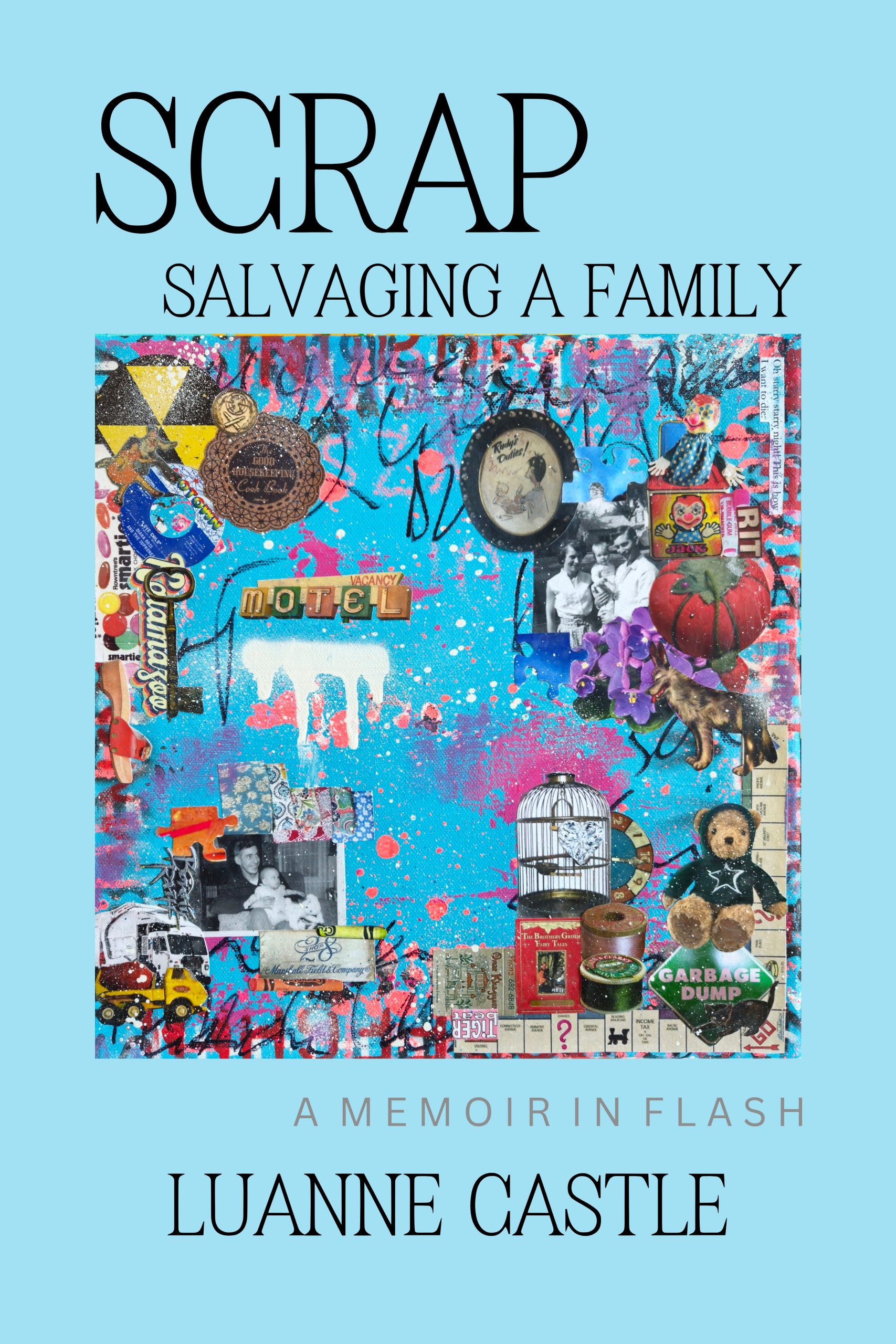
Scrap: Salvaging a Family by Luanne Castle
Review by Wilma J. Kahn
ELJ Editions
ISBN: 978-1-942004-35-6
Luanne Castle is a bright star in the firmament of poetry and flash prose. Her writing has appeared in innumerable literary journals, and she has published four award-winning poetry collections—Rooted and Winged, Our Wolves, Doll God, and Kin Types. Her new memoir, Scrap: Salvaging a Family (ELJ Editions, 2026), marks yet another achievement.
A memoir in flash, Scrap focuses on three discrete parts of Castle’s life in relation to her parents, especially her father. “Scrap” is a multivalent word around whose every meaning and nuance Castle fashions poignant—and sometimes horrifying—flash prose and poetry to reveal her family in all its human pain, mystery, and love.
Parts I and II depict Castle’s harrowing youth and teen years; her father, Rudy, wounds her spirit with inexplicable bursts of anger and escalating punishments—innumerable “bare-assed spankings,” groundings, deep humiliations, even threats with a gun. Part III focuses on the change in their relationship in her father’s last months of fighting cancer. We see Rudy’s sincere quest for Castle’s forgiveness, as well as her compassion for him.
Castle’s memoir is full of mysteries, the foremost of which is who was Rudy’s father? As the memoir moves into Part III, we learn his identity, which gives rise to a whole new set of questions. Will his father’s “legitimate” family recognize that Rudy stems from the same man as they? Will the “legitimate” family see that their grandfather cruelly doomed his “illegitimate” family to fatherlessness and poverty? Will his “legitimate” family appreciate that Rudy’s family is not just scraps but possesses value equal to their own? And finally, do the opinions of the “legitimate” family even matter, for despite his father having abandoned him, Rudy is a person of merit.
Before I read Scrap, Castle told me, “Keep in mind this is a mixed-genre story: flash/scrap/poetry/longersomething/musing called interrogating, etc. So don’t look for something that feels the same all the way through. The idea is that it doesn’t.” I beg to differ. No matter what form appears on any given page of Scrap, I hear Castle’s distinct voice. It’s her voice that sews together these written “scraps” and makes her remarkable crazy-quilt of a memoir whole.
Scraps are a central theme in this narrative. Rudy’s seamstress mother uses scraps to make a crazy quilt, doll clothes, and Castle’s childhood clothing. Rudy salvages odds and ends of metal to make sculptures. And Castle painstakingly fits together scraps of information to reveal the identity of Rudy’s father.
Another theme is scrappiness, which is what enables the “illegitimate” family to survive and thrive. Unfortunately, Rudy’s scrappiness often oppresses his daughter and wife. Scraps and scrappiness are fused in these lines from the poem “Scrap” (p. 5):
A scrappy boy fuses
himself a father out of wants
Out of the gritty street pavement
Out of throwing away the hurt
Out of fighting and scraping
punching cracks and potholes
Scrapyard salvage appeals to him
Each scrap reveals a system
Steel gears, bolts, and bushings
rake heads, trowels, posts
wire aluminum and copper, tin
everything, brass hinges, fittings
he rearranges and solders into
magical monstrosities
A third theme is masks. Rudy’s frequently slipping mask reveals a snarling wolf face that brings to mind Castle’s Our Wolves. Consider these lines: “…. the wolf teeth inside him are shifty and unpredictable” (p. 13). Consider also, “Your blanket isn’t sanitary, a woman who resembles my mother tells me. She’s the one I’ve suspected lives underneath a mask” (p. 8).
Castle has written for years about her complex relationship with her father. She has sewn the “scraps” of her writings into a crazy quilt of terror, mystery, courage, forgiveness, and beauty. Contemplate these final words (p. 151): “…. I believe my father will be with me until I die. He’s with me when I spend an extra hour working at the end of a long day, when I hold doors open for strangers, and when I putter away my spare time by making and organizing. He’s with me when I’m unforgiving and too hard on myself. And when I look at my grandfather’s portrait or remember my father asking me for information about the man, my chest swells with something wistful, perhaps even hopeful.”
One final word of advice. It’s all well and good to read my review, but please buy a copy of Scrap to treasure for yourself. It’s one of the finest and most compelling memoirs you will ever read.
About the Author
 Wilma J. Kahn’s poetry and prose have appeared in Writer Site, Encore, Thirteenth Moon, The Little Magazine, The Comparatist, Shofar, World Book Encyclopedia, and elsewhere. The author of Big Black Hole (Worldwide Mystery), she was also a Finalist in the Pirate’s Alley Faulkner Society Competition and recipient of an Irving A. Gilmore Emerging Artists Grant. She has led creative writing classes for older adults since 1999.