
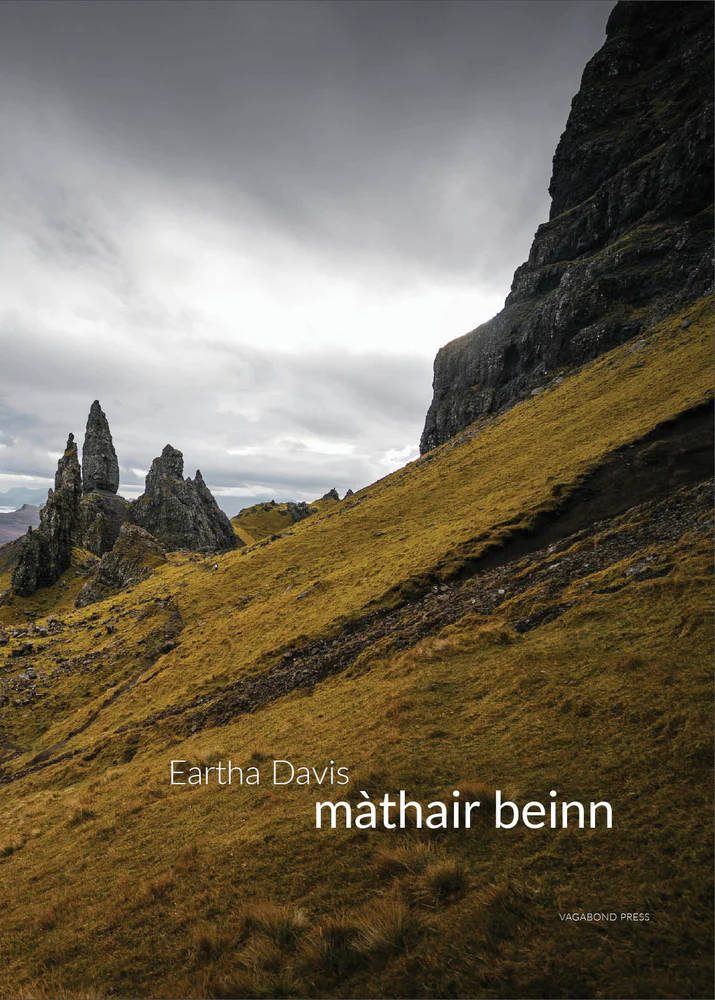
Review
A Reliquary Landscape:
Eartha Davis’ Màthair Beinn
Review by Maureen Alsop
Vagabond Books
ISBN: 978-1-9255735-77-2
Eartha Davis’ debut collection, màthair beinn, is a reverie, a dream within a semiotic sequence, where language entwines, layers, and unfurls, creating a new dialogue with the natural world. Davis’ poems open into a space of transcendence, a lyrical bardo, where wholeness — as human identity — shifts and surrenders to a textural ‘language within language.’ Here, semantics stop, recalibrate, and embrace intuition.
The collection totals forty-six poems, each of which hosts a title in Scottish Gaelic. Nowhere in the book are the poems’ Scottish Gaelic titles fully “translated.” This act of integrity elevates the reader’s interaction with the work. Divided into two balanced sections, the Gaelic titles act as talismanic guides. On three occasions, Davis offers translation, two subheadings ‘boireannach: woman’ and ‘beinn:mountain,’ which direct the reader toward a subtle feminist awakening and a matrilineal understanding of the “mother mountain” (the English rendering of the title). Beyond the two subtitles, one poem, titled “birth,” is in English. This unveils a primal theme as a revelation, of truth and of source, defining and framing the inherent interaction of one’s ‘mother tongue,’ “a migration of light jewelled with hunger” (p. 70).
Language systems, like nature, are subject to the possibility of endangerment and extinction.[1] Though màthair beinn does not appear, at least overtly, to set out to establish a political intent, the book holds its ground to ensure awareness of how language plays upon political domains and asks questions about lineage and loss. Without succumbing to translation or the laze of interpretive nuance, the reader is offered an opportunity to meet language with the heart, to strive toward a higher level of understanding, of voice, of appreciation without diminishment. The collection reminds us of poetry’s origin: song, memory, invocation, connection. The poems allow the reader to step into another culture and experience the universality of devotion.
In the poem “atairechd nan mara,” Davis writes:
to taste the soft gallows
of love. Let me be
winter one, snow one…
The lines evoke a faint echo of Macbeth: “Speak, if you can: what are you?”—and ascertain an emotional tenor. The pulse of love as oceanic, the pulse of the tide as a natural syncopation; the heart—the source where love sustains, even through pain (“the gallows”) and the cold. Love conjures a “one” who crosses a reliquary landscape, a life-affirming scene, a channeling and a coalescence, where the earth mitigates and opens to musicality. The landscape itself, a holy relic, Davis’ poems illuminate time’s thickets. And with it, a myriad of ghosts. Moths ruffle up from the pages.
And through these stirrings, Davis is a guide. The poems stitch together ancestral language with a contemporary joy. Beauty binds the physicality into a deepening awareness: life, surging with familial presence and eminent spaciousness. Language, as witness, is transmitted into new terrain through the vehicle of voices past.
In “a dhíonnsaigh an t-solais” Davis writes:
I am ferrying us
lightward/tucking
our prayers
under
symphonic
shells/ I am ferrying us
heartward … (p.45)
The poem is an invocation and a transom. Davis carries the reader with confidence and delicacy across worlds, reminding us of spaces that exist between the living and the remembered. The voice carries us up, out of ether, to witness what is both far and near, places we could see or reach if only we are willing to look or to listen.
As each poem’s capacity underscores faith and respect, it is clear these are sophisticated poems, that inhabit a loving trust in language. Davis’ poetry honors the profundity of communion, of intuition, and of hunger. The hunger for the greater human love which surpasses and is transferred through generations. Davis reminds us what poetry can be: vast, inexplicable. These poems restore the aural art: poetry as song.
Davis’ words are indeed of ‘the one who sings..’ In the poem “an neach a tha a seinn,” she writes:
Look:
cinders
are soaring
towards
tendered
tides/ plummeting
back
into
the chest
of
the
Earth/… (p. 76)
This musicality, the alliteration towards/tendered/tides sing. The singing, celebrates myth, and decants legacy.
The Gaelic map sculpts nature and is benediction. The poem’s switchbacks: mineral rich, vistas of spiritual intimacy.
Gaelic is the road which decants in sublimated hypnotic, ecstatic image— incantatory, transitory and sublime. As if the title is a koan, a haiku, a fragmentary epigram.
As a reader, one can be grateful for the opportunity to decant each title from its native tongue, to be steadied by time and to seek a deeper companion in understanding.
Perhaps tree is mother daughter lover
a soil-bound sun warmed by the livingness
of a human palm…
(craobh a’ghaoil, p. 20)
At its heart, màthair beinn is a meditation on connection: between generations, land and body, language and belonging. Davis’ poetry holds reverence for the unseen forces that shape our lives. These are erudite, technically assured poems. They are also generous and clear.
In an era when linguistic and ecological losses often occur unnoticed, Davis reminds us that poetry is a vessel for preservation. màthair beinn is an exceptional debut. Davis emerges as a planetary poet—whose work enlarges the possibilities of the contemporary Australian canon.
[1] UNESCO data indicated “one language dies” every 14 days; video extract on the subject by article author.
About the Author
 Maureen Alsop, PhD is the author of eight poetry collections, including visual poetry and an experimental/hybrid novel, Today Yesterday After My Death. Her book reviews have previously appeared at Your Impossible Voice, Poemeleon, Prairie Schooner, ANMLY, Rain Taxi, The Rumpus, among other literary journals. Visit maureenalsop.com for more.


