Review
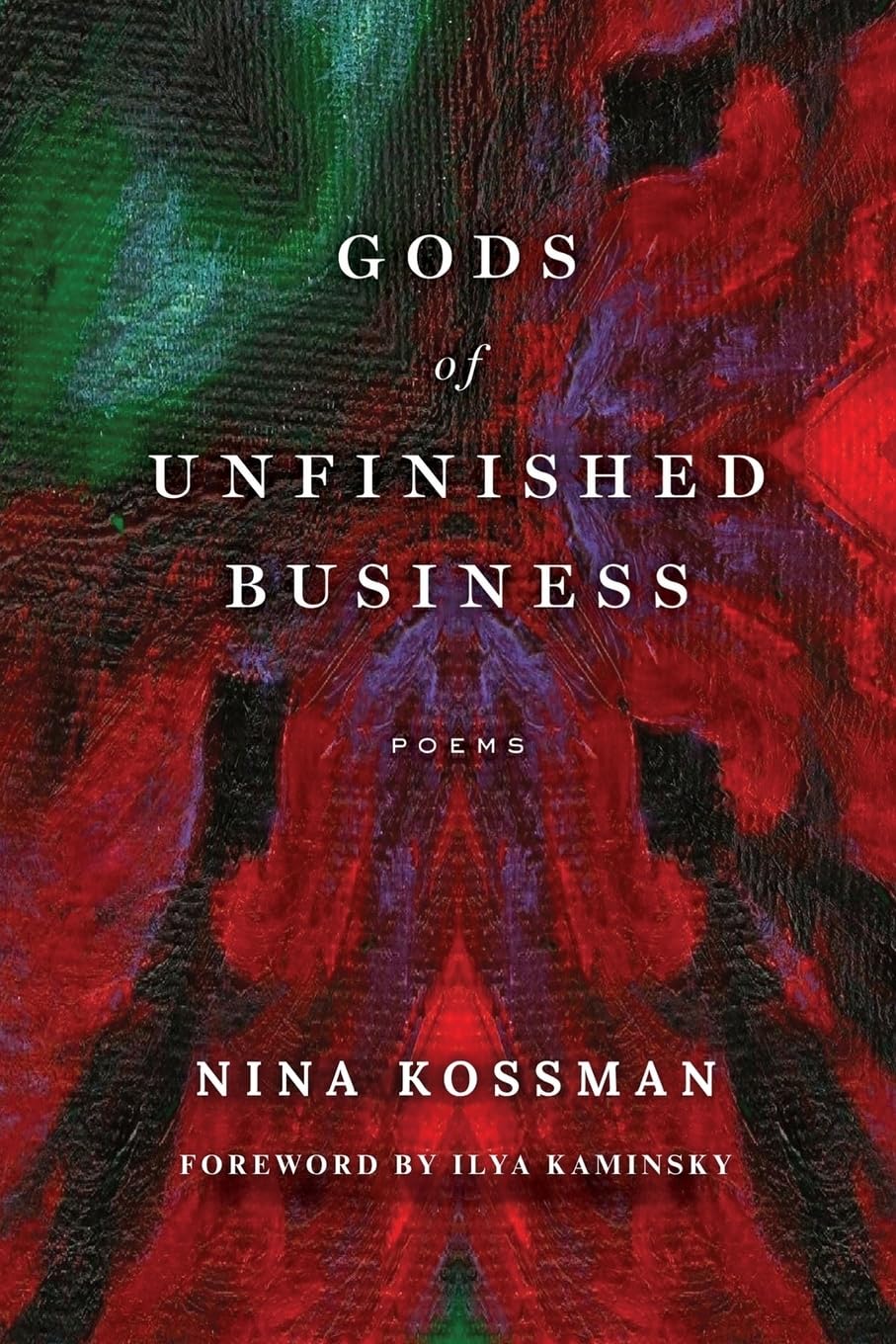
The Inescapable Nightmare: Gods of Unfinished Business by Nina Kossman
Review by Art Beck
Cervena Barva Press
ISBN: 978-1-950063-64-2
Gods of Unfinished Business is subtitled Poems on History Transformed into Myth. For me, Kossman’s poems evoke Joyce’s characterization of history as a maze of nightmares that his alter ego, Stephen Dedalus, is trying to escape. The book opens in prehistoric Mesopotamia with “a faux re-creation of an ancient Akkadian text” on Ismul, the Boy Warrior. The poem is a long parable on the futility and ignobility of warring humanity. Several pages and a generation later, the warring, then war-renouncing, Ismul speaks:
I split myself into parallel moons,
I spill myself into a bowl of blood –
You will see me the salt of your body,
you will hear me think in your thoughts…
When I offer you one face of the moon, you know:
my face is the face eaten away
by years of sickness and hunger,
face of a child who died
fifty years ago.
A similar sad thread runs through Kossman’s re-creations of Greek myth. Most are succinct, often ironic meditations on the same conflicted figures that drew the 2oth-century Modernist poets: Ariadne. Leda, Daphne, Cassandra, Odysseus, Agamemnon, Alcestis, and more. All trapped in their own myths. But anachronistically interjected among them, she has some “Words for Danton” who “If you hadn’t learned how to write the word ‘execution”/ before you learned how to write the word “pardon”/my friend Danton…” But of course, this is why “you are a revolutionary”. (Who famously ended up under the guillotine blade himself.)
In the book’s second section, Kossman takes us to another failed “revolutionary,” the Galileo precursor Giordano Bruno, burnt upside down at the stake. Even as the Inquisition’s pyre is ignited, he composes a vindicating apologia in his head, insisting that, indeed, the earth revolves around the sun. His ashes are collected in a sack and emptied into the Tiber.
That brutal execution is followed by “One by One”; a poem narrated in the collective voice of the ordinary Ukrainian Jews, lying “like sardines” in the bottom of the Babi Yar pit alongside their children. They’re shot “one by one,” and those holding infants “two by two” with bullet-economizing single shots. The ghosts buried in their mass grave watch their assailants as they “succumb to senility” and “one by one” enter the ground in “gilded coffins” surrounded by their mourning families.
One by one
our bones come to meet you –
it’s an open house day,
we meet and greet new guests;
you don’t recognize us
but no matter
we watch you
from the bottom of our pit,
as you lie awake
clumps of earth in your empty eye sockets
remember
how easy it was
how much fun you had;
pif-paf, pif-paf!
It’s worth noting that Babi Yar isn’t identified in the title or poem. Nina Kossman came to America with her family as a young girl from the Soviet Union. She’s a long-time New Yorker but continues to publish poetry in Russian as well as English. This is one of several poems in the selection that feels like it may have been originally composed in Russian. Even beyond its ending “pif-paf”, (Russian for “bang-bang”), it speaks to us in a Russian voice. By not naming the event (which would probably be instantly recognized by any Russian reader) the scene becomes reborn, as it were, awakened from its historical nook.
Later in the book, she has another poem actually titled “Babi Yar”. A bitterly sardonic piece about a family getting ready for a walk in the forest because “the Krauts are knocking on the door again.” That poem is preceded by one titled “Upon Seeing a Portrait of Genrikh Yagoda on a Wall in a Moscow Police Station”. For current generation readers, Kossman does footnote Yagoda as the Stalin era NKVD Director who supervised “arrests, show trials and executions of countless innocent people”. What she doesn’t mention is that this widely publicized police station scene is that of Alexei Navalny’s arraignment, before being taken into custody, never to be released. The poem recites a litany of NKVD victims reaching down through generations like a genetic disease.
…so many inheritors of what can’t be described
so many grandchildren of victims
so many grandchildren of perpetrators
that even the memory of whose grandfather
was a victim, and whose a perpetrator
has been lost.
Are these poems all gloom? Surprisingly not. Like all good poetry, the very act of their being written releases a certain unnamed hope. As does the book’s final lyric sequence with short poems like these.
Perched Between Pities
kiss their hands
soiled with dogwood
veined like a leaf.
Kiss faces of kinship
of the earth-and the heart
flowing sleep-swift,
to the shy, the sad ones
whose eyes no other eyes
seek; whose words
freeze in the unheeding air.
Go to them; see:
neck deep in pity
your awed self, sealed.
How Slowly the Seagulls Circle.
See how slowly the seagulls circle
their wings flapping sleepily
over the red clay by the lake,
the same clay from which the Greeks
molded their narrow vases
with patterns from the lives of the gods
(those who own the secret of death,
turned out to be subject to it) –
gods made from red clay
at the lake of sleepily circling birds.
To further stretch my already-stretched opening metaphor: Stephen Dedalus’ mythic namesake finally did escape his impossible maze. Tragically so, because myth is tragic. But he soared, if ultimately alone, into the freedom of the open air.
About the Author
 Art Beck’s Opera Omnia Luxorius, a Duet for Sitar and Trombone won the 2013 Northern California Book Award for poetry in translation. Mea Roma, a “meditative sampling” of Martial epigrams, was a runner-up in the American Literary Translators Association 2018 Cliff Becker Book Prize. Etudes, a Rilke Recital was a finalist in the 2021 Northern California Book Awards. His selected poems, Angel Rain, was published in 2022 by Shanti Arts Publishing.
His most recent book publication is A Treacherous Art: Translating Poetry. Shearsman Books, 2023. This selection of essays includes a number that originally appeared in Your Impossible Voice, including “How Not to Review a Translation.”