Review
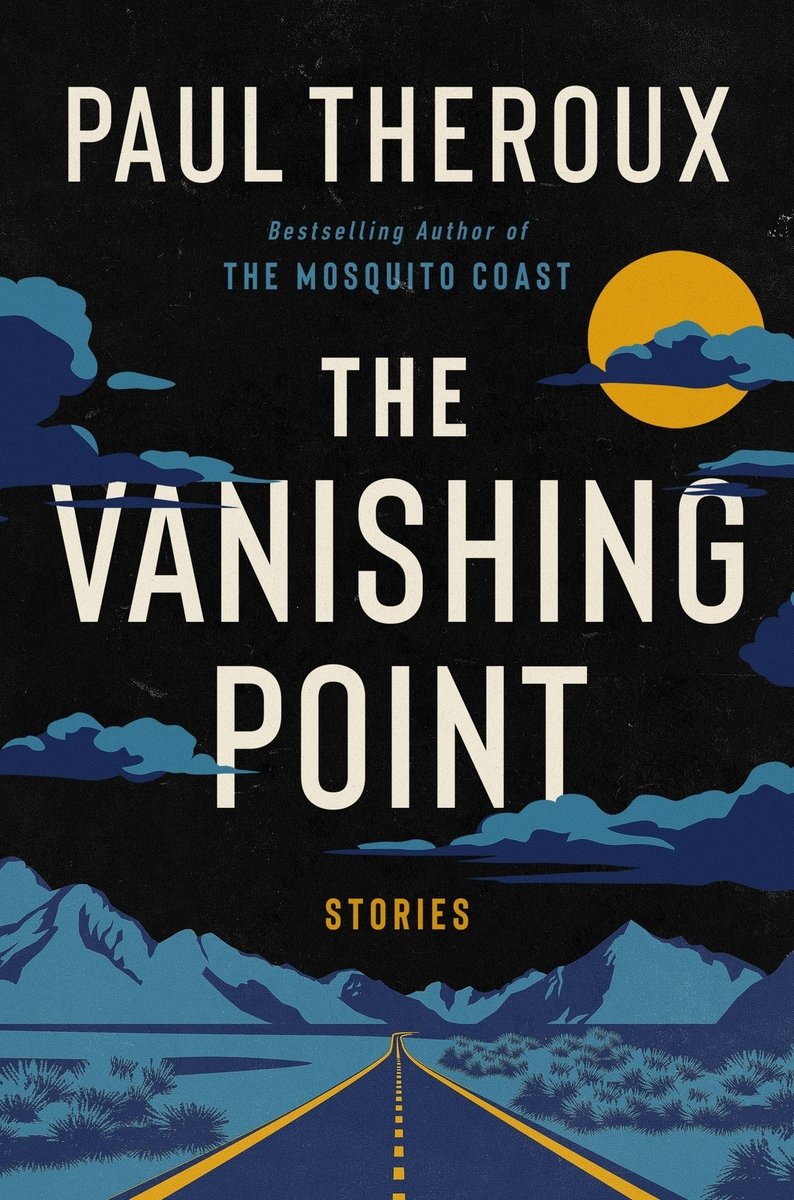
Paul Theroux’s Late Tapestry: The Vanishing Point
Review by Daniel Picker
Mariner Books
ISBN: 978-006-343252-9
Perhaps to escape the cold doldrums of the depths of winter, wherever one resides, Paul Theroux’s new book of short stories, The Vanishing Point, offers a bright, warm light as his first such collection in over a decade, and proves that Theroux, as an octogenarian, has not slowed his literary output, nor has his literary prowess diminished. This collection joins his previous short story collections, including The Stranger at the Palazzo D’Oro and Other Stories (2004). But more recent than Palazzo, Theroux also released two other collections, including Mr. Bones (2014). All of this short story production through these and several more collections was in addition to the publication of many novels, essay collections, and travel books, over fifty-five books, including the novella, Half Moon Street, set in England, where Theroux lived for many years; that novella became a film featuring Sigourney Weaver and Michael Caine. Theroux gained fame with The Mosquito Coast, which also became a film of adventure, featuring Harrison Ford, and more recently a TV series featuring Theroux’s nephew Justin Theroux.
Now in his early 80s, Theroux has bridged literary trends and eclipsed or joined his contemporaries, while outliving the authors he most admired: Graham Greene and V.S. Naipaul, while tapping into the rich vein of tales set on far continents, joining the adventure genre stretching back to the work of one of Theroux’s revered masters: Joseph Conrad.
Among those literary forbears, Theroux also engages and joins a narrower niche, further stocking the shelves of a narrow, mid-20th-century subgenre: supermarket fiction. John Updike’s most-often anthologized story, “A&P,” appeared in The New Yorker magazine, then in his collection Pigeon Feathers of 1961; Frederick Barthelme’s “Safeway” appeared in his collection Moon Deluxe in 1983. And now we have Theroux’s down-to-earth tale, “Stop & Shop,” filling out this subgenre. Barthelme’s short stories, if not only “Safeway” in particular, brought forth the critical pejorative “K-Mart fiction.” “Safeway” makes indirect allusion to Updike’s economical stroll across the linoleum and takes readers through a realm of once frozen, then soggy waffles and often cold, mostly disinterested women. But Theroux’s story contains more narrative depth, as a youthful store worker and high school soccer player finds his place among Unionized working men, who represent a world rife with lessons of these working-class men, with life experience beyond what the young protagonist finds on the preppy interscholastic soccer pitch.
Andre, or Andrew, the main character in “Stop & Shop,” competes for his public school as a wing on the soccer team, but he is not first string, even as his team dominates Newton High and Philips Academy. Theroux notes: “Because so few schools had soccer teams, we played the Tufts freshmen and the Harvard freshmen and the prep schools, and we had not lost a game.” As the story continues, a game looms ahead on a Saturday, which conflicts with work, against a team the players call “Governor Dummer.” Theroux’s narrator notes: “The belief at our public high school was that … poorer, tougher, more athletic, highly motivated boys attended public school.”
In addition to this class conflict, there’s the conflict between work and soccer for the young high schooler, as Theroux’s story also captures the bristling tension between labor and management, between “Crotty” and the regional supervisor “Hackler.”
While Updike, and later Barthelme, have crafted fine stories, by chance set in American supermarkets, Theroux’s tale offers a particularly earthy lived, work experience.
Theroux organizes The Vanishing Point into three distinct groupings, all of which follow the initial eponymous story: “The Vanishing Point.” This initial tale, with its double-edged meaning, relates to the vanishing point involving art and perspective, and the more simplistic or earthly vanishing point of mortality. Theroux’s stories in his new book engage these issues with aplomb.
The first section, “Hawaii Nei,” focuses on Theroux’s home state of Hawaii and contains six stories, including “Hawaii Sugar,” a tale rich with local history. The second section, “Elsewhere,” includes stories set in Africa, with “Headmaster” and the equally brilliant “Father X” inspired by a remark from expatriate author Henry James, and set in Theroux’s native Boston. Paul Theroux, like Henry James, lived for several decades in England. In Theroux’s tale of the mysterious Father X, the narrator begins by bringing forth the remarks of his own father: “‘The worst of deafness is not silence,’ he said. ‘I could bear that. It’s that I can actually hear voices, noises that sound like words spoken in the next room. But I’ll be damned if I can understand them.’” The death of the narrator’s father leads to difficulty concerning his death certificate, then his birth certificate, and the difficulty in “authenticating” the father’s death because his true identity appears a mystery, which becomes a complicated mystery the son, the narrator of the story, endeavors to unravel. This rich story contains a depth quite missing from contemporary fiction, and from much of the “K-Mart fiction” of the past forty years.
Theroux’s “Headmaster” is set in Africa, where Paul Theroux first lived as a young man and Peace Corps Volunteer. This experience led to Theroux’s friendship with Trinidadian author V.S. Naipaul, which became complicated over many decades and across several continents. Naipaul lived in Africa only briefly, but the continent inspired perhaps his most brilliant book: A Bend in the River. Theroux’s story, “Headmaster,” which shares a similar setting and characters of similar, yet different cultures, describes a clash between these cultures, does not suffer in comparison with Naipaul’s masterwork, and evokes the tensions, frustrations, and dangers of life in Africa, as it moved from Colonialism into the developing world.
But as in the story “Father X” and in the final section of The Vanishing Point, “Aide-Memoires,” Theroux appears at his best when setting stories on his original home turf of Massachusetts. The first three stories of this final section, “Camp Echo,” “Stop & Shop,” and “First Love,” seem most akin to Theroux’s best stories from his previous collection, The Stranger at the Palazzo D’Oro: from its section under Boyhood Secrets: “Pup Tent,” “Seeing Truman,” and “Scouting for Boys.” A later edition of that older book introduced the three stories following a different section heading; rather than “Boyhood Secrets,” the same tales fell under the heading: “A Judas Memoir.” In the second edition, the story “Pup Tent” instead appears as “Holy Week.” Those three stories, as do the newer stories under “Aide-Memoires,” certainly have the quality of a powerful memoir, and the second heading for the older stories, containing “Judas,” seems problematic. But those stories, like the best new works in “Aide-Memoires,” have power and authenticity.
Paul Theroux, born in 1941, grew up in the 1940s and ’50s, in Medford, Massachusetts, and graduated from the University of Massachusetts, Amherst in the early 1960’s. He previously spent his freshman year at the University of Maine at Orono, and Maine figures in the initial, title story: “The Vanishing Point” in this new book; that story appears as a novella of about 40 pages. In the tale, a bachelor itinerant carpenter helps a successful abstract painter, and the carpenter’s help later leads to a fortuitous unrolling. This sort of O. Henry ending serves as an anodyne and appears welcome after the challenges the carpenter has endured.
Theroux has enjoyed considerable success over a long career; he owned the private Calf Island off the coast of Maine and has divided his time between Hawaii and Cape Cod for decades.
In this collection, The Vanishing Point, Theroux’s varied life across continents and decades intertwines with contemporary issues, including ancestry, personal identity, and gender identity. In the penultimate story, “The Silent Woman,” set in Hawaii, an academic colleague notes a particularly “epicene” student could assist the aging scholar. Late in the story, the narrator realizes his error concerning his youthful, yet often self-absorbed, research assistant, “Ollie,” who has helped him; the old author seems a stand in for Theroux himself; in this story Theroux describes the last day with, “Ollie” who appears still “thickly hatted” late in the story, then Theroux describes brilliantly “dark” hair, and: “The long lustrous hair swished with the head shake, the earrings danced.”
In the background for many of these stories appears Theroux’s youth, which, intertwined with the Catholic faith, shaped the lives of his characters here, and the lives of his parents, and the early lives of Theroux and his siblings, including Theroux’s brother, Alexander, a novelist and former Catholic monk. Many of the strongest stories in this late collection emanate from the familial richness of Theroux’s early years. Paul Theroux, through the rich prism of his family background, his life abroad, and his wide travels, along with his catechetical questioning, paints brilliant frescoes and weaves rich tapestries after eighty years of life, in “The Vanishing Point.”
About the Author
Daniel Picker is the author of a book of poems: Steep Stony Road (Viral Cat Press of SF). Daniel Picker won The Dudley Review Poetry Prize at Harvard University, where he had previously studied with Seamus Heaney. Daniel’s memoir, Eat Your Good Lamb on Heaney appeared in The Oxonian Review of Oxford University, where Daniel studied in Lincoln College Oxford. Prose by Daniel Picker appears in The Georgia Review, The Philadelphia Inquirer, Harvard Review, The Sewanee Review, The East Hampton Star, The Oxonian Review of Oxford University, The Irish Journal of American Studies, The Stanford Daily, Middlebury Magazine, Rain Taxi Review of Books, The Almanac of Menlo Park, CA, A New Ulster, and many more. Daniel received a fellowship from The Geraldine R. Dodge Foundation.