
Essay
Listening to Rilke Redux
by Wally Swist
The following essay serves as the introduction to Swist’s forthcoming full-length book of translations, If You’re the Dreamer, I’m the Dream: Selected Translations from Rilke’s Book of Hours (Finishing Line Press).
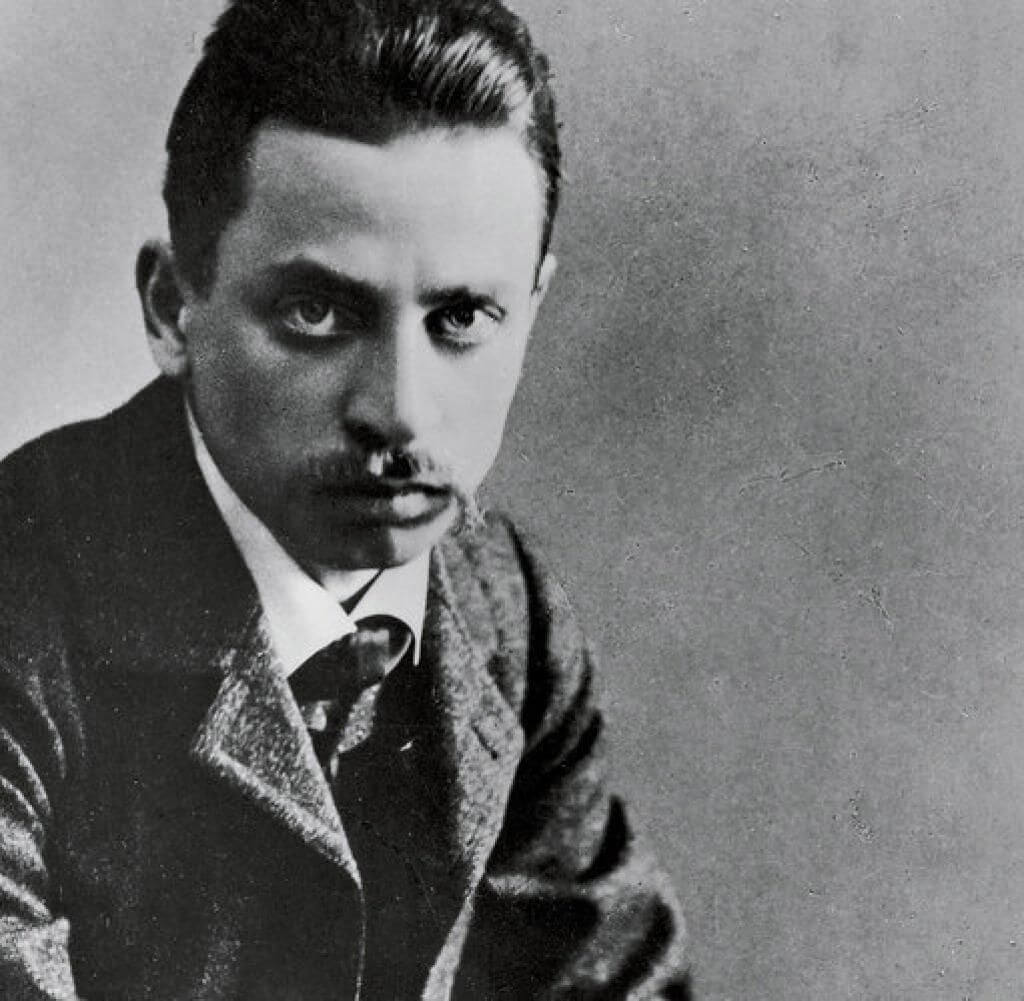
I first began reading Rainer Maria Rilke in the autumn of 1973, when I was twenty. His work filled me as few other poets would, both then and in the decades to follow. I read widely. My list of favorites grew as I read even more: Jacobsen, Jimenez, Lorca, Milosz, Neruda, Trakl. Yes, they were often poets found in translation. However, I also had my list of American poets, such as Jack Gilbert, Donald Hall, Robert Francis, and Mary Oliver, among a host of others.
Rilke, though, held me, opened up to me in various rereadings. His mysticism was not only attractive, but I also saw it as a possible path on which I could learn to guide my own life. I never saw Rilke’s angels, but I could feel the presence of my own.
Another attribute in my early reading of Rilke was that I knew Stephen Mitchell, who was a graduate student at Yale at the time. Stephen would often stop me in the street, between classes, to show me his most recent Rilke translations. He would open his briefcase and pull out newly typed translations, reading some lines to me first in German, then in English, to illustrate how musical Rilke sounded in German and how he was trying to cast a similar lyricism in English.
Decades later, in October 2017, I revisited Rilke, as I often have over the years, in my rereading of The Duino Elegies and The Orpheus Sonnets. The sequences availed themselves to me as they had never done before. I experienced a mystical breakthrough in my reading of the work. This resulted in my writing a couple of tribute poems to Rilke, “Two Echoes for Rilke” and “Rilke, at the Chateau de Muzot.” This was followed by my translating a poem from The Orpheus Sonnets, Part Two, XII.
In the summer of 2018, I had another mystical experience in my reading of Rilke. Doors opened where I wasn’t aware any doors were. I came upon C. F. McIntyre’s 1947 translation of Rilke’s Das Marienleben, or The Life of the Virgin Mary, a sequence of thirteen poems of various lengths. The sequence was composed by Rilke in 1900 during his Worpswede art colony years. This was before his years spent under the aesthetic tutelage of Rodin as his personal secretary. This was on the cusp of the Romanticism of the 19th century and the modernism of the 20th century.
I have admired many translators of Rainer Maria Rilke’s poetry. Of course, there are Stephen Mitchell’s translations, many of which I was graced to see in early drafts. I have also admired Edward Snow’s work, and more recently, that of the erudite poet and translator from San Francisco, Art Beck, whose versions, especially of The Orpheus Sonnets, are as crisp and vital as they are vehicles for Rilke’s angelic visions and poetic rapture.
However, there were poems such as the ones included here that nearly, tacitly spoke to me audibly. The words and the images opened to me as a poem of my own would—but with Rilkean splendor. I had to rush to write down what I was hearing, and it seemed, at least at the time, that I was also listening to my inner angel.
The intent of this essay is to offer praise to the poet who cited praise as the highest form of poetry. In Rilke’s praises, we find our own praise—of ourselves, of others, of mostly anything, actually. When anyone experiences an epiphany, that person wants to share that epiphany. When you have experienced many, it is very nearly an imperative that others know and hear the song, or songs, that have led to the opening of the light.
May my interpretative adaptations become threads woven into the fabric of Rainer Maria Rilke’s work in English. May it lead to exploring Rilke’s major works as fully as any reader can, which demand, for many reasons, a multitude of rereadings. The work contained here led me to my own experience of what is mystical and to further it. May this same work open for you in a similar way and provide nurture and sustenance, as it has for me.
However, what I have found continually in the many rereadings of Rilke’s The Book of Hours is best stated by Wolfgang Leppmann in his inestimably valuable biography of Rilke, entitled Rilke: A Life (New York: Fromm International, 1984). This paragraph is quoted from page 115:
“With the New Poems, the Duino Elegies, and the Sonnets to Orpheus, the Book of Hours is one of the masterworks of modern German poetry. Its title is taken from the “livres d’heures,” breviaries compiled for lay worship and often ornamented with means of structuring the devotional day. Taken together, Rilke’s poems do represent a spiritual journal . . . The sense of breviary is underscored by a fictional device that is followed consistently in the first book, sporadically preserved in the second, and abandoned in the third: the individual poems are in fact prayers being recorded by a Russian monk in his cell.”
With this in mind, translating such a work into English is a humbling task. Although, as Leppmann posits, the quality of the lyric is masterful, and taken with Rilke’s early insights into spirituality, since these were poems written when he was still a young man, aim high to articulate what is the unspoken inviolate streaming of the deep and expansive spirit, so to attempt to translate that into English is to craft, at best, as a translator, Rilke’s inner angel as well as yours and mine, so the difficulty is in each detail, and angels, as we well know, love to dance on the head of a pin.
About the Author
 Wally Swist’s new books include Aperture (Kelsay Books), poems regarding caregiving for his spouse through Alzheimer’s, and If You’re the Dreamer, I’m the Dream: Selected Translations from Rilke’s Book of Hours (Finishing Line Press). Poems, essays, and translations have appeared in Anomaly, Chicago Quarterly Review, Commonweal, Consequence, Healing Muse, Montreal Review, Poetry London, Rattle, and Your Impossible Voice. Huang Po and the Dimensions of Love (Southern Illinois University Press, 2012) was selected by Yuseff Komunyakaa as co-winner of the 2011 Crab Orchard Open Poetry Competition. He was also the winner of the Ex Ophidia Press Poetry Prize in 2018 for A Bird Who Seems to Know Me. Books of nonfiction include Singing for Nothing: Selected Nonfiction as Literary Memoir (Brooklyn, NY: The Operating System, 2018) and On Beauty: Essays, Reviews, Fiction, and Plays (New York & Lisbon: Adelaide Books, 2018). Shanti Arts LLC published his translation of Giuseppe Ungaretti’s iconic first book, L’Allegria (2023). Wild Rose Bush: The Life of Mary and Other Poems by Rainer Maria Rilke was selected as an honorable mention in the 2025 Stephen Mitchell Prize for Excellence in Translation sponsored by Green Linden Press. Bainbridge Island Press will be publishing the most recent collection of his poetry, Discovering What to Say.

