
Issue 33 | Fall 2025
from Cityscape with Sybarites
III
The cellphone’s alarm woke me up to a bunch of pillows, a crumpled blanket, and the pungent smell of my armpits. I hadn’t registered Marina’s absence; her belongings were gone. I showered. The shock of cold water made me realize the precariousness of my situation: I had to leave the apartment before Aparicio arrived and I had to find Marina. There was also the matter of employment: three days left. Alternating among my worries, I stuffed what I could into an old hiking backpack. Marina didn’t answer. I tried again, as if expecting the phone to understand that I had no other way of establishing contact with her. While I moved downstairs, the creeping hangover seemed to lend each emotion a distinct, overpowering physicality.
Eight in the morning. It was crowded. The people were dressed in the usual leftovers from an untraceable season, for they knew no one was looking. Washed-out jeans, with and without leather belts, with and without pockets, with and without arabesques, came and went. The sun-bludgeoned and the sun-deprived faces alike displayed impassivity as part of a uniform. No fastuous earrings or necklaces dangled in the vicinity; only varying shades of white powder, indifferently set, betrayed a haphazard ritual. Hair was a scant privilege. Rectilinearity too. The sweat, the grocery bags and the laptop cases, the loose threads and the food stains, merged their incongruity in a steady assault and, reflecting a dearth of beauty, gave the people the impertinent look of bureaucrats. Among them, Marina would have exacted devotion. Or perhaps she would have been met by the common leer and the common grimace. The privilege of devotion could only be mine.
In a widening fit of despondency, I collided with a vagrant—tall, shirtless, emaciated. He looked at me with wild eyes and pulled out from his profuse beard the figure of a virgin, comically small; he began waving it in my face and screaming in an invented language. Given my fervid state, I didn’t move. I stared as he called for others’ attention to his virgin. I was moved, so moved, in fact, that a strong current of sympathy filled me with half-deranged thoughts: this man alone, in his great anonymity, in his disdain for the act of making a living, had known the interred love that fills our veins and preached its immensity to the few who could listen; yes, yes, the nondescript figure was an aid to that tortuous tongue; it was woman who held the key, or rather each woman held a key; no, that was absurd, inattentive to the rawness of his despair; it was a specific woman who had pushed him into the fertile abyss! He was a brother, then, made manifest for both our benefit. I wished to embrace him, to tell him that I saw myself in him and did not blush, did not feel any embarrassment. But the recognition crashed when a young couple passed by and, giggling, seemed content to exist in a hug and not in a separate, arbitrary realm. Opportunely, too, since the high priest and parishioner of his own religion began stripping his pants off and peeing in the direction of an ice-cream stand. Some cameras, a thickset guard with a slice of pizza, and the relative indifference of most bystanders inundated my spirit with bathos. Sobriety and the dawn of singledom were proving unsuitably mystical.
Guadalajara has never been for the sober. It preys upon the senses of the robust and the frail, which results in murderous apathy and in unhinged receptiveness. I needed, at the very least, a cup of coffee and a quiet table. Nevertheless, I had to gain distance. I couldn’t afford an encounter with Aparicio. He would look for me in the obvious places: Guayacán, which he favored because of the vertiginous rotation of young waitresses; El charro catrín, which I favored because of Yolanda, the beautiful head waitress who knew by heart my erratic tastes; and Al filo del café, which we both favored because of the prices. Yet he’d probably leave for last the “fag streets.” So I rambled through the closed discos and bars. Here, there was a measure of silence, but insidious pranksters had made sure that every roll-up door and gate in sight bore a cock, preferably shooting an endless stream of cum. That’s the unwritten law: if you want peace and obscurity, you’re getting marked; if you want trouble and attention, you’re getting ignored. You must walk a tightrope like the rest. I was on the tightrope.
After a long, tiresome walk, in which I lost any sense of orientation, I spotted by accident what looked like a café; it could’ve been one of those barbershops the size of a hunger-stricken student’s room or an improvised stationery shop. The semi-opaque, nameless door revealed the outline of a counter with a cash register. I approached. The strong smell of coffee rid me of my tension. I walked in, relieved. The locale was narrow and long, like a spy thriller’s air duct: some fifteen tables were set in a row, with a healthy distance between them. Five were occupied: by a coughing nonagenarian who read his paper sound asleep, by a pair of old men who played chess, by a construction worker who cleaned the dirt off his fingernails with a precision cutter, by a street clown who took absurdly long drags of his cigarette, and by a nun who fanned away the smoke while she read a gossip magazine. The only employee, an overweight mustached man who made a baroque embroidery of his baldness, didn’t take notice of me, or pretended not to take notice. I sat at the last table, next to the bathroom. Again, I surrendered to an ominous feeling. What was the use of hiding if Aparicio and I worked in the same place? Did I seriously expect our colleagues to intervene when it got ugly? Was this the purpose of a marginal life—to knock at doors, to flee from professed friends? And who was he, anyway? A brat of nature who detested the purely intellectual sort of corruption that characterized his father and fought to make it physical; an autodidact in violence who wished for lifelong learning, whose body was offered in sacrifice without second thoughts. And what of the joy he scared off? A woman who had known only the silence of her inner entrenchment, who had displayed suspicion in all her dealings with others, whose body was a soul congealed; a specter who would efface its vestiges in memory and bring about the miracle of reversal, of time repealed. I was being lured into the aristocracy of suffering. And then the announcing angel.
“Do you sell cigarettes?”
“No smoking here.”
“I don’t mean to be rude, but that guy over there is pleasantly hidden in smoke.”
“You’re not a regular.”
“Oh. Guess I’ll make do with the secondhand smoke. What’s the name of the place?”
“You want coffee?”
“Not what I expected, to be honest. Maybe La capilla or La catacumba, but not that. Yes, yes. As black as my thoughts. Is there a menu? Or is that for regulars, too?”
He left neither annoyed nor diverted. He was within eyeshot. No coffee machines. Only a French press. His attention to the task was enough to dignify it, even if there was nothing gracious about his movements. Still, I needed to blabber nonsense, to drop anchor without.
Every breath gets shorter: I’m still in the middle of a jeremiad: her features straighten like a spread blanket: I continue as if they had warped: she reaches for my arm: the attempt at rejection unwinds a gap: hospitals, oxygen masks: she lays me on the couch: her hair is let loose and its contact with my skin deepens the entrance of air: I breathe.
The taste of coffee brought a shock as revelatory as that of the cold bath. I felt grateful to be done with Aparicio and hopeful about Marina. As soon as I told her the news, she would regain her trust. I always found a way forward, circuitous and disgraceful though it usually was. But she knew the odds. You watched everyone at the table bringing the casino to its knees: they won a round with fifteens and sixteens against a ten, they won another with miracle transformations (a fifteen became a twenty; a thirteen, twenty-one), then another win with aggressively stupid hits. Electrified, you joined them; they were euphoric. Now came the thirteens, the fourteens, the fifteens, the sixteens, the seventeens just for you. Out of nowhere, a twenty—and the whole table lost to a natural. Your new friends started leaving, with an awkward smile and a pat on the back and a good luck. It was just you and the thirteens and fourteens and fifteens and sixteens and seventeens. You’d been counting. You’d been hamming it up, and here you were: crushed, down to your last chips. What’s more: the loss had nullified days of hard work. That’s when you visualized the long haul. Chance has her minutes of wild benefaction, even for the humblest of gamblers. That’s when you remembered you’d turned them to hours. Marina knew. It was time to back-count.
About the Author
Israel A. Bonilla lives in Guadalajara, Jalisco. He is author of the micro-chapbook Landscapes (Ghost City Press, 2021), the short story collection Sleep Decades (Malarkey Books, 2024), and the pamphlet Phoretics (Paradise Editions, 2025). His work has appeared in Firmament, Able Muse, Minor Literature[s], new_sinews, Exacting Clam, and elsewhere.
Prose
Leeuwenhoek’s Lens
Eric Williams
Cate’s Upstate or Fashion After the Apocalypse
Elisabeth Sheffield
from Cityscape with Sybarites
Israel Bonilla
The End of My Sentence
Roberto Ontiveros
Storing Dinosaurs
Dan Weaver
Winners
Julia Meinwald
Tiered Rejections
Stephen Cicirelli
Brother from Another
Jaryd Porter
The Robinson-Barber Thesis
Joyce Meggett
Point of Comparison
Of the Lovers
Addison Zeller
Another Place
Addy Evenson
Poetry
Let’s Sit on the Bench and Chat
Tatyana Bek, translated by Bita Takrimi
Blueberries
Edward Manzi
Crow calls from the top of a pine.
Crow dreams an eerie peacefulness laced with fear
Peter Grandbois
past is a flame
Karen Earle
Cover Art
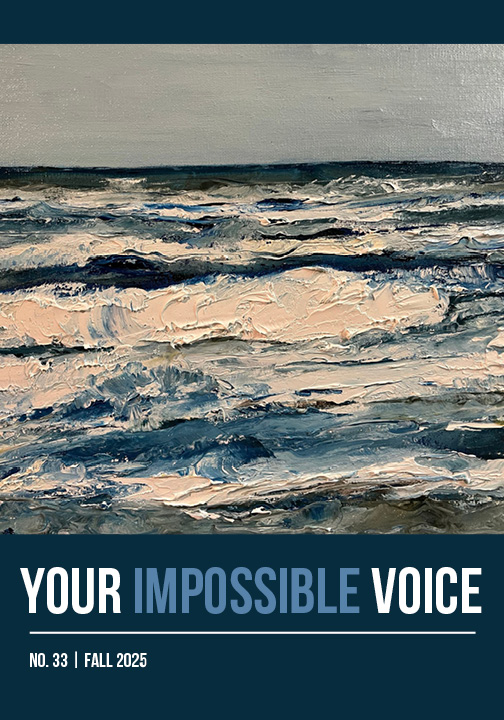
Ocean Beach I
Judith Skillman