Review
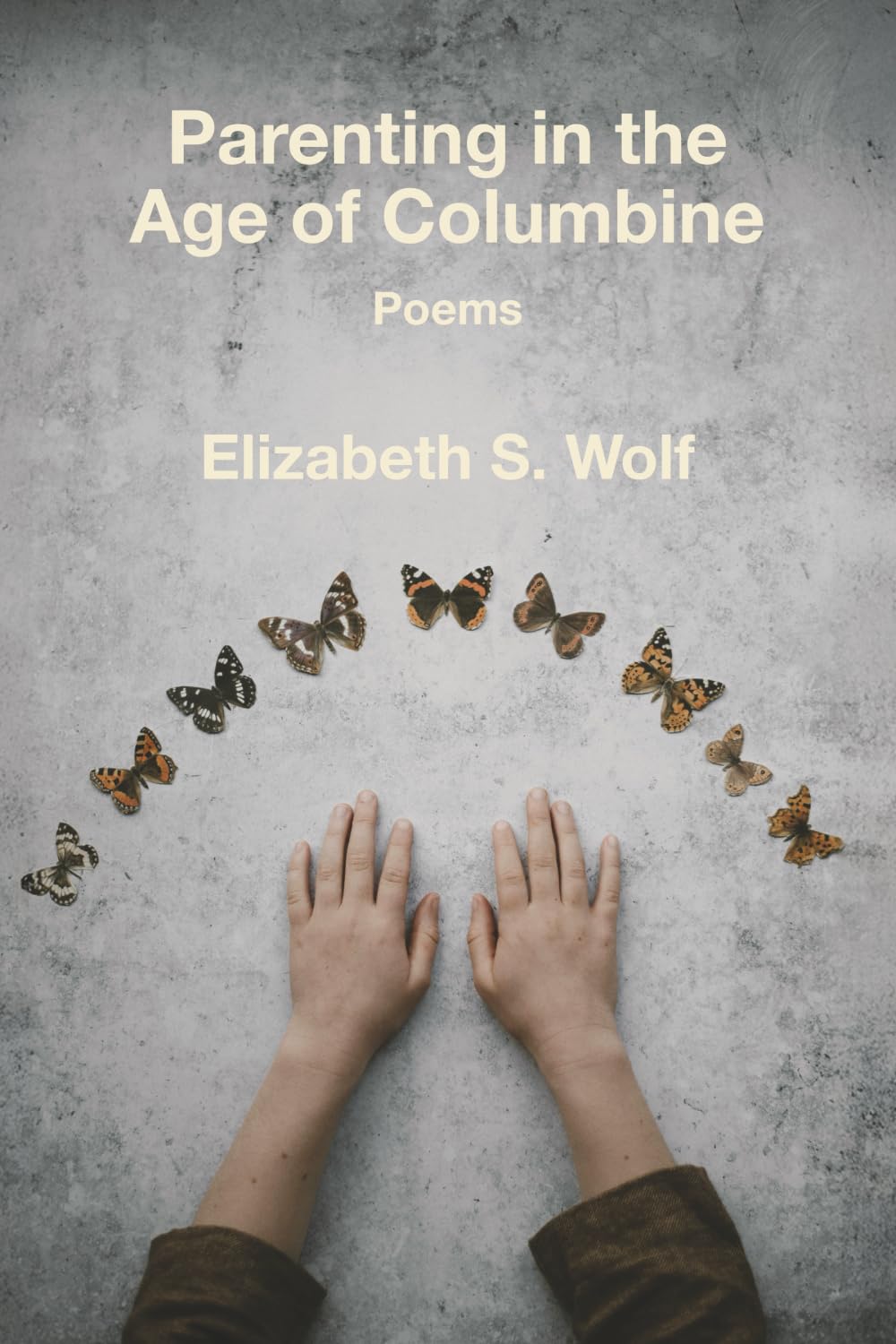
Parenting in the Age of Columbine by Elizabeth S. Wolf
Review by José Enrique Medina
Kelsay Books
ISBN: 978-1639808519
Parenting in the Age of Columbine, by Elizabeth S. Wolf, is strongest not at the level of individual poems but at the level of book design. Many poetry collections feel assembled; this one feels built. Organized around Columbine, Sandy Hook, Parkland, and Uvalde, the collection follows the speaker’s daughter from birth through young adulthood, allowing the reader to experience the history of school shootings through the intimate lens of motherhood. The result is a collection animated by a compelling question: what does it mean to raise a child in America after Columbine?
Wolf’s greatest strength is her ability to connect public tragedy with private experience. In poems such as “Parenting in the Dark,” “Sammy Island,” “18 and Overseas,” and “When the Phone Rings,” national violence is not treated as an abstract political issue but as something that quietly enters kitchens, parking lots, doctor’s offices, and family relationships.
The book’s most moving moments occur when the ordinary anxieties of parenting collide with the extraordinary reality of a country shaped by recurring mass shootings. In “18 and Overseas,” when someone asks whether her daughter is safe while traveling abroad, the speaker responds with one of the collection’s sharpest observations: “do you think she is safe here? // freckle-faced boys / with AR-15s / American as apple pie.”
Another strength is Wolf’s resistance to easy answers. Rather than reducing complex events to villains and victims, she repeatedly asks difficult questions about responsibility, grief, warning signs, and the limits of parental knowledge. Poems such as “Wayne Harris” and “Dylan’s Mother Susan Klebold Gives a TED Talk” explore parental love alongside uncertainty and regret. The collection’s most unsettling poem may be “Ben, We Hardly Knew Ye,” which follows a teenage friend fascinated by Columbine who dies by suicide at fifteen. What makes the poem so heartbreaking is its restraint. Amid discussions of school shootings, self-harm, and warning signs, Wolf focuses on ordinary details that become devastating in retrospect. After Ben calls the speaker’s daughter shortly before harming himself, the call goes unanswered. Wolf’s response is painfully simple: “Sometimes even kids miss calls.” Elsewhere, the poem reveals how information remains hidden, as children often keep painful truths from adults. The speaker learns only later that Ben had been dubbing “metallic music with reverberating screams” over Columbine security footage, while her daughter had concealed other troubling details, including that Ben had created a Facebook page as Eric Harris. These omissions suggest not parental neglect but the tragic reality that children often keep secrets from the adults who love them most. Ironically, the impulse to protect those adults can deepen the very isolation that makes tragedy possible.
The poem also gestures toward the splintering effects of identity in the digital age, where young people can create alternate selves that drift further and further from those around them. Yet Wolf refuses to force these details into a tidy explanation. Instead, she leaves readers with the unforgettable image of “Six sophomore boys carri[ing] a coffin heavy with questions.”
The collection’s extensive research never calcifies into documentation. Wolf’s notes section reveals a deep engagement with the subject, yet the poems themselves stay porous—open to doubt, to tenderness, to the particular. In “When the Phone Rings,” a daughter’s call home becomes a stay against the collection’s accumulated fear: she describes how “there were clouds reflected in the glass / of the Hancock building, like the blue sky / was both solid as a tower and as / gossamer as hope.” By this point in the book, hope isn’t a sentiment—it’s something the speaker has had to fight to keep.
What Wolf has made is not a chronicle but a reckoning—with the country, with motherhood, and with the specific texture of loving someone in a place that keeps failing to protect them. Beneath its examination of violence, grief, and uncertainty lies a quieter, more enduring question: how do you keep raising a child toward a future you’re no longer sure you can promise?
About the Author
 José Enrique Medina is a queer Chicano poet, playwright, novelist, and literary critic. His debut poetry collection, Only the Dead Let Me Talk This Much, won the 2026 Lambda Literary J. Michael Samuel Prize. His chapbook Haunt Me won the 2025 Rattle Chapbook Prize, and Man Without a Skirt was selected by Ellen Bass as the runner-up for the 2025 Two Sylvias Press Chapbook Prize. His work has appeared in USA Today Hispanic Living Magazine, Los Angeles Review, Best Microfiction 2019, and elsewhere. A PEN America Emerging Voices fellow, he is the founder of the Chickens & Poetry Residency for Writers. Connect with him on Instagram @MedinaWrites or at MedinaWrites.com.