Review
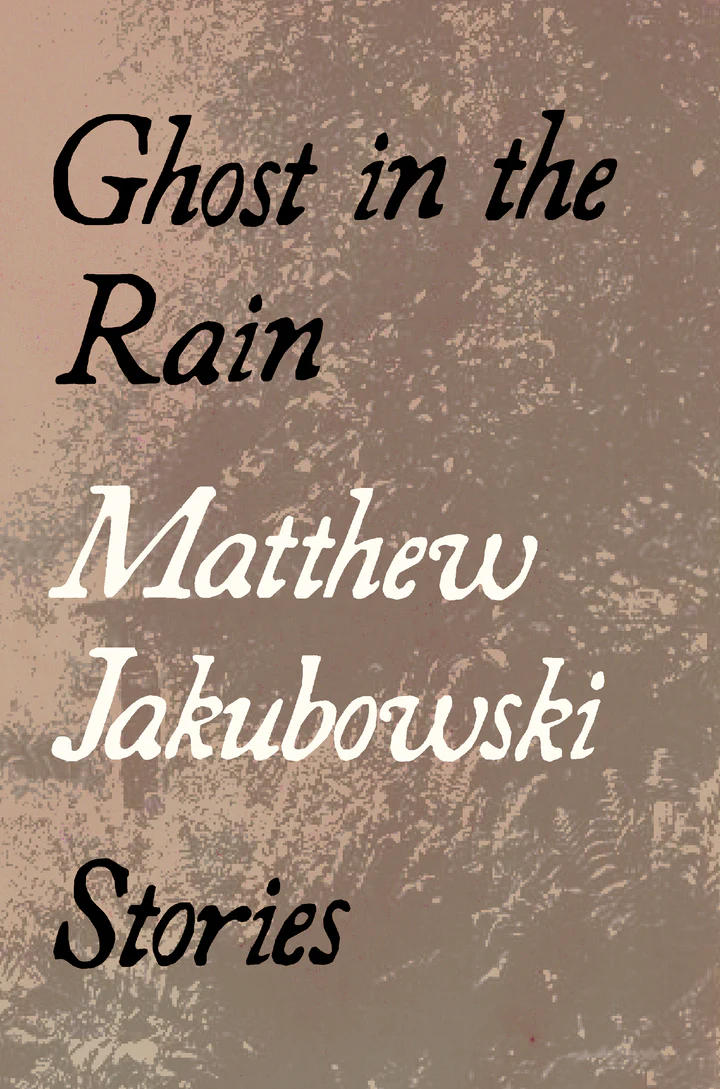
Ghost in the Rain by Mattheww Jakubowski
Review by Kelsey Squire
Bottlecap Press
ISBN: 978-1-969492-60-0
In Matthew Jakubowski’s chapbook Ghost in the Rain, the story titled “Particles of Death” opens with a question: “What is it that keeps us alive?” This question, “what keeps us alive?,” runs throughout the stories in this volume. The stories hover exquisitely on the line between “flash fiction” and “prose poem.” Whatever label is used, Jakubowski uses deft twists and turns of language to launch readers into completely unexpected scenes, each grappling with unique takes on this question.
What keeps us alive? Readers of Ghost in the Rain could think of this question literally. The narrator in “Particles of Death” says “A cold bottle of water after work is refreshing, too, and we all know how crucial hydration is before a journey, to flush away deposits of guilt and cancerous irony. I am prepared” (12). Water is a running motif in these stories, sustaining life and prompting close observation. In “Cut Shapes from Raindrops,” the narrator grapples with intense, conflicting emotions, studying the “jubilant” raindrops running down faces in a photograph, or recalling a “stolen raindrop” that “begins to boil with fury” on the tip of the tongue. In “The Book of the Rain,” the narrator encounters a forgotten, soggy paperback that still contains treasures: “In the sunshine later, the pages will stir as the water keens to the songs of the air and sky and evaporates to join them.”
What does it mean, to be alive? Many of the stories in this collection playfully probe the divide between life and death. The opening story, “Ghost Story,” opens wryly: “Ghost with a gun. Ghost in the desert. Ghost wearing a cool hat.” As we follow our ghost, some lines border on poetry, like “Ghost who wears a white sheet sometimes, and sometimes has shadowy feet, which sometimes make a slight noise, just for fun. Ghost with a good sense of humor that’s lost on almost everyone.” The playful tone shifts to a more poignant, plaintive mood: “Ghost having a bad day. Ghost wearing the jersey of that team everybody hates. Ghost with a shoe on its head. Ghost watching Ghostbusters and crying.” The story shifts again in the final paragraph (no spoilers here!) but it is easy to see why this one earned a place in Best Microfiction 2024. In other stories, readers encounter cyclical moments of life, death, and rebirth. These moments prompt readers to consider the complexities of our relationships more deeply. In “Little Brother,” the narrator and his family live entire lifetimes in 24-hour cycles, experiencing the joy and vexation of living within a family, but also growing and drifting apart to live separate lives. “Caretakers” evokes the weirdness of the Covid-19 pandemic quarantine, as the narrator and their neighbors acquire sets of twelve parents. “Every other week,” the narrator explains, “two of my parents wake up dead. It’s my job to bury them in the backyard at the appointed time when my neighbors and I are each allowed to go in our backyards.” Without being literal, the story evokes the conflicting feelings that might seem familiar to readers from that time, from a hollow emptiness, to hypervigilant anxiety, to cozy togetherness.
What keeps us alive? Words. Stories. The stories in this collection take on mystical, mythical scenes that stretch our imaginations and language to their limits. In “The Hunt” and “Demarcation,” the narrator grapples with his father’s quest to hunt Jesus, “who is stalking Ronald Reagan,” near the border of a Berlin Wall. In “Alight, Astray,” a gang of kids skips school and encounters the tentacled Mr. Tuesday. In “The River Birch” a man leaves his wife to start a romantic relationship with a tree. In “A Death in the House of Nostalgia,” a princess grieves the death of poetry: “Rhymed verse—the nation’s romantic voice—had perished in an electric fire; its printed music would be heard no more.” In “Gathering,” we’re in the darkness, the woods, experiencing fear—”the simple thing we’ve all known since we first lay awake as children.” Throughout each story, Jakubowski weaves words into a vivid world. These stories remind us that the world may be unsettling and weird, but Jakubowski also fills his worlds with the things that sustain us, the things that keep us alive—like love, courage, and hope.
About the Author
Kelsey Squire teaches writing and American literature at Ohio Dominican University in Columbus, OH, and is a co-editor at The Willa Cather Review.