Review
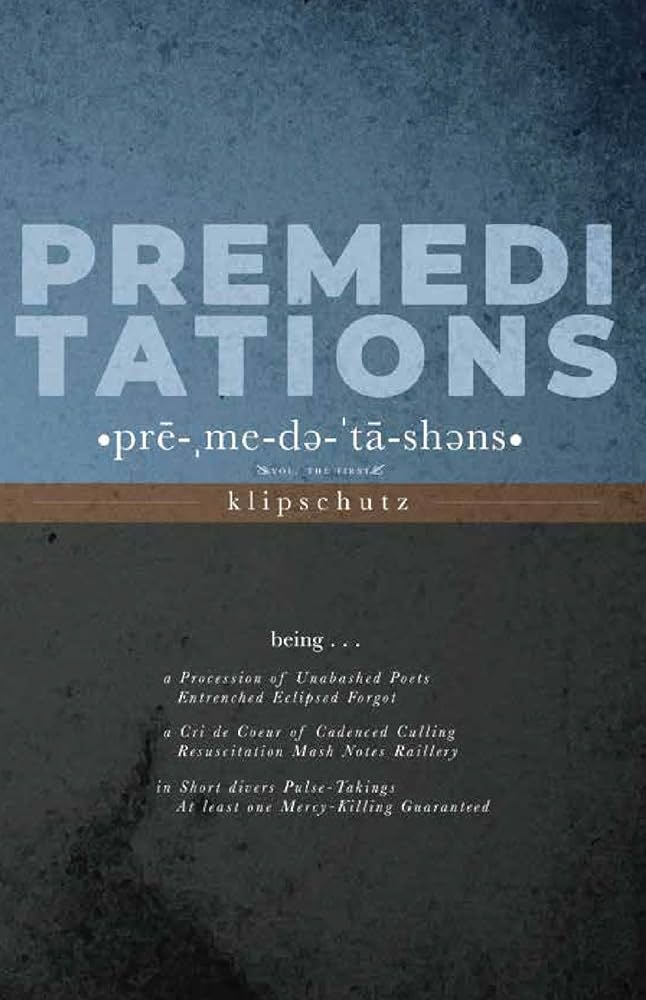
Ignoring Poetic Schools: Premeditations by Klipschutz
Review by Art Beck
Hoot n Waddle ISBN: 978-1-7335859-1-0
This book has been out for a half dozen years and was well received for a small press volume. But I just came across it a few weeks ago and was so happy to read it that I feel compelled to publicly respond with my thanks to the one-named San Francisco poet, Klipschutz.
More than one school of poetics has posited that the subject of poems should be “poetry”. Klipschutz largely ignores poetic schools. His subjects are the poets themselves. An eclectic array of mostly 20th century notables and not so noted practitioners, ranging from W. H. Auden to the already unremembered, Bay Area’s Darrell Gray. Auden gets a page with three short poems beginning with “Words of Wystan’ which starts with the italicized line “Poetry is small beer …” Whether this is a slight misquote (did Auden say “poetry” or “art” in general?) doesn’t matter. The following poem, Obiter Dicta offers “He was full of quotes and urges/of shit stains and conversions./ I can still see the crumbs/he couldn’t be bothered/to wipe off his coat.” But the tone throughout is that of fond, homely homage to the avuncular, good-natured mess that nurtured a cathedral of disciplined Modernist verse.
Unlike Auden, Klipschutz once schmoozed with the hard boozing Darrell Gray, who also gets his own full page titled “Lost and Found”, a three part prose poem that recounts that when “several years later (Gray) died too young … his adoptive parents in Indiana had his literary remains, strewn about his disaster-zone Berkeley apartment, destroyed.” In the second and third stanzas, Gray, like his Country Churchyard namesake, seems to wander ingloriously among gloried ghosts like Frank O’Hara, Mayakovsky and Borges. Klipschutz ends; “Gray founded a movement, Actualism, on April 17, 1972. Many books, many lovers. He won my heart with his “Ode to Jibberish”. Charmed and chased off everyone he knew. Made a will, never found. In an alternate-reality time-space continuum, which gem might his executor have salvaged from the cat-piss-soiled piles on his floor.”
En-face from Darrell Gray is a memoriam to Joyce Kilmer, titled “Delirium’. It opens
Joyce Kilmer was a man
who wrote a thousand rhymes
and died defending France
at the Second Battle of the Marne.
Survived by eight iambs.
Three wars later, Spiro Agnew
took the trouble to reply,
if you’ve seen one tree,
you’ve seen them all.
The aptly titled poem then wanders in free association with lines like “So then why so many Nixons / each unlovelier than the next?” And ends on an un-memorial, self-referential note.
…besides the stray snatch
of a poem from ancient Sumer,
and the odd shard behind glass,
not much really lasts,
not even Nixon. George Sand,
on the other hand, was a woman.
And I, on my honor, am a tree.
If you’ve unseen one of my poems,
you’ve unseen them all.
in memoriam, 1886 -1918
That ending would border on the snarky if it weren’t directly preceded and redeemed by this passage:
… O Memory!
I think a German sniper
that I shall never see
cut Joyce Kilmer down
a poem as lovely as
almost a hundred year ago.
Don’t you agree?…
Reading this legerdemain, the image of the idealistic young versifier/volunteer, now remembered only for a mostly unmemorable poem, touches the heart simply, without sentimentality. I do agree.
By rough count, there are some seventy-five such pieces in Premeditations. With subjects as wide-ranging as Cavafy, Emily Dickenson, Roberto Bolano, and Kay Ryan. Meandering some American icons, Klipschutz gives us wry, but not askance looks at Wallace Stevens, Robinson Jeffers, Robert Frost and the domestic banter between William Carlos Williams and his wife Floss. Who reminisces how “her Bill circumcised Hemingway’s son/(the hunter nearly fainted)/ in a tub”.
All these pieces seem to find just the right distance from their subjects to engage them as humans as opposed to poetry-revered objects. Their satire is gently un-barbed, and eschews meanness. A good example is a long mourning poem written in the voice of Anne Sexton’s husband titled ‘Alfred Fowler (Kayo) Saxton’. In the poem Anne becomes “Carolyn Saxton ” Their daughters, Linda and Joyce are also given new names. We filter our view of the protagonists through this cosplay as Kayo relates their marital troubles and broods on his poet wife’s Confessional circle. Then ponders “the pins stuck in “that poor Ted Hughes.” The stage names deftly allow us to hear Kayo’s last sentence as coming from an actor on a tragic stage, distanced from personal rancor.
She belonged to you, the readers,
the self damned, and I to her,
and Wendy and Hope. I’m glad
she happened. I’m glad it’s over.
And I’m glad to have read Klipschutz’ sui generis forays.
About the Author
 Art Beck’s Opera Omnia Luxorius, a Duet for Sitar and Trombone won the 2013 Northern California Book Award for poetry in translation. Mea Roma, a “meditative sampling” of Martial epigrams, was a runner-up in the American Literary Translators Association 2018 Cliff Becker Book Prize. Etudes, a Rilke Recital was a finalist in the 2021 Northern California Book Awards. His selected poems, Angel Rain, was published in 2022 by Shanti Arts Publishing.
His most recent book publication is A Treacherous Art: Translating Poetry. Shearsman Books, 2023. This selection of essays includes a number that originally appeared in Your Impossible Voice, including “How Not to Review a Translation.”