
Issue 32 | Spring 2025
Xiaolongbao, My Love
Karen An-hwei Lee
As far as I can recall, my first dream in the plague of absentia was not about soup dumplings but simply about wastefulness. In a long waiting room, men and women in lab coats stood before a porcelain gullet, smooth as a swan’s throat. Every few minutes, a flushing toilet boomed in the room, and people were dragged by a force into the porcelain gullet. By the end of a hundred days, no more people would be left in the holding room; all men and women would be pulled by an invisible vortex into the origin of the flush. No one knew what their day or hour might be. A handful of brave men and women would attempt to crawl out of the gullet, only to be irresistibly pulled back into the roaring, cavernous light. The Registry and its indices of names and bibliographies, furled and enfolded like a multifoliate rose or a maze of pages, merely showed blank spaces for those who became the vanished, known as the generation of nones. Was it the space inside our own heads, a place without an inch of air, other than the oxygen shuttled to and from in our blood molecules, the hemoglobin in our sealed rivers, our veins and vessels until we bleed? What irresistible force was at work, and what invisible hand of fate selected those who were whisked away? Inside our heads, those bowls of noodles bathed in blood and saline, there is none of us who recalls a time when we lived through a season of vigilance and came out at the other end, knowing who we were in the plague of absentia.
As a humble dumpling-maker and poet, am I truly one of the generation of nones vanished from the Registry, erased in the data migration? If questions are banned, how do I stop asking them? Is there more to this mysterious plague than the mossy solicitude of Marimo, the moss ball, who follows me everywhere, a roly-poly buddy of maddening, sheep-like contentment? There’s no one to ask. I miss the ubiquitous analysts in the borough and the elegance of their questions, jiggling doorknobs so quietly: How would you like to use this time? How can I help you? What brings you to tears today? Instead of unfolding my maps of parks and reservoirs, I take the bamboo vats out of my pantry and dream about walking to the overseas night market in the wee hours in search of ground pork, scallions, water chestnuts, ginger root, and a sack of flour, the xiaolongbao ingredients now at a premium among pantry staples like sugar.
In a waking dream, lest I dematerialize without witnesses, I begin to make my favorite dumplings thanks to the muscle memory in my fingers, rolling out the skins from scratch with a floured rolling pin. I make pounds of dumpling dough, then sourdough starter and double-rise yeast breads, scallion pancakes and naan, pillowy tortillas and lavash.
I open the tins of water chestnuts and drain the cloudy water.
I set out the squares of parchment paper for each dumping.
The paper squares remind me of the origami instructions for a crane.
I mince the scallions with a quick cleaver, close to my fingers.
I do not touch my face despite the puffs of steam.
My name is Zinger, not ginger. Yes, I’m banned.
I’ll zing you for misidentifying me.
My hair is swept into a snood, a fastidious net of yore.
The wood cutting board tilts over a mixing bowl of pleasures—
The joy of tofu swimming in sesame oil and soy sauce.
I am grateful for you, xiaolongbao, my love.
On days when I feel more optimistic, the Bureau of Misidentification will prevail in this plague of absentia, I’m sure, and recover the names of the lost. Maybe I have too much faith in their fallible mode of governance. Meanwhile, the quarantine has made the cloudy water in the canals lighten to aquamarine—the color of parasols in fair weather gardens—and the darting schools of fish return. The apparitions of the past return in droves. Soon after the fish came back, the wild swans return, coupled for life. Belled jellyfish float in the waters, ribboned and blooming, followed by pods of dolphins swimming in the canals, free of water traffic. The fish were always there, other inhabitants said. We couldn’t see them for the polluted water and stirred sediment. The clarified air sends the faraway mountain ranges to the realm of the seen, the dusty color of elephants at a distance. The beauty of the earth, unbounded by our human circumference, churns in a warm, radiant abundance.
In the plague of absentia, I love crunching the bacon of grief, kummerspeck.
Bacon, yes. It’s tastier than popcorn or flavored rice cakes, or even its cousin, the salty pork rind. It sounds odd, but this word, kummerspeck, is translated grief bacon. I read that this psychological condition is kummerspeck in some contemporary analyst circles. It’s a legitimate condition, if I may, a very real diagnosis. I once kept a box of plant-based bacon, made of soy, beet juice, and pea protein, in my ice box. When I felt idle, I’d microwave a few slices of plant-based bacon to dull the boredom. It wasn’t real bacon, of course, but rather, fermented soybeans called natto sort of pounded into thin strips, not diced in cubes like tempeh. I would be lying, however, if I told you that the plant-made version tasted like real bacon.
Of course, nothing is especially harmful about frying actual bacon and eating it, crisp slice by slice, standing up at the sink, staring with a dazed expression at nothing. If that takes care of grief, why not? This might even be considered a reasonably healthy way of coping with distress, say, rather than drowning one’s sorrows in the river or indulging in harmful, maladaptive behaviors. There’s nothing wrong with a little bacon from time to time as an innocuous jot of consolation, whether apple-wood smoked, thick-cut hickory, maple, mesquite, or teriyaki, the strips of breakfast bacon arranged in their ruddy rows, crisping and sizzling in the skillet.
I’m afraid of planes falling out of the sky in the plague of absentia. No one knew why the airlines continued to schedule the ghost flights, as we called them, despite the loss of passengers. This sort of needless ghosting was a shame, my balloon and I agreed while tilling the soil around the sprouting lavender and sage in my window boxes. The lacy, blue rosemary was blooming, and the wild honeybees, oblivious to the world of contagions other than their own or those afflicting their gardens, flew away bedecked with pollen like airborne crumbs of egg cake. The honeybees notably failed to disengage from one another, innocent of the recent executive orders for social distancing. Their furry gold bodies full of nectar and laden with sweetness, they flew single-mindedly to their papery abode, tucked like a rowboat out of water, hooked under the eaves of a house across the borough, a wax cathedral of molten hunger. The bees are unfettered and free in their desires, at liberty to wing their way through the world at will, a honeyed choreography of buzzing harmony.
In the early days of the plague, the green moss ball and I waved cheerily to the neighbors, who gestured back from their balconies. Or rather, I waved while the moss ball and its shadow floated like a flightless sea bird marooned on an ice floe. It struck me that I did not know any of their names, blank as the hours I spent piddling away at a list of miscellaneous household chores—make your own mud mask using a homemade recipe of clay mud, and honey; use wood glue to seal the cracks where the ants enter during the winter rains; treat bathroom tiles with mildew remover; read about the loving care of aquatic moss balls. How do you thrive, I would ask the moss ball, when the rest of the borough is so miserable? If I stared enough, the moss ball would appear to nod—just lightly, so—as if to say, if you only knew what it is to grow from a mere figment of photosynthesis, filtering water and feeding on light.
Never once did it occur to me that a year of vigilance might arise, one where I’d seek to simulate rather than sedate my neural networks of the passing hours. One day soon, I will board a red-eye flight, and the passenger in the window seat next to mine will lean over, saying, do you remember? Then she would pause, lowering his eyes, as if to say, in absentia. I lost my good friend in the great data migration, she’d confide, her seat belt firmly buckled. The Bureau of Misidentification could not find her. As we flew over mountains, rivers, and gorges, she would point out the shooting stars—one, two, three. I would crane my neck to peer out the window only to see nothing—look for little flying sparks or fireflies, she would say—and if they happen upon the same digits of the hour, they’re angel numbers, she’d add. What do you mean by angel numbers, I’d reply without a question mark, still conditioned by the default ban on books, no questions asked. Angel numbers, she would say, like eleven after eleven or two minutes to two. I would nod, although I don’t believe in angel numbers; it’s magical thinking; and there, just for speaking to me, right there, I’ve stitched her drowsy voice into my paisley notebook with the moss balls I doodled on the cover.
One, two, three. Is our vanishing only a matter of time, a fact of our mortality and its finitude? Will we all lose our identities, banned by default after the great data loss? After the loaves of bread on the shelves vanish, then the flour runs out, or rather, is subject to strict rationing: one unit of flour, butter, and salt per customer, followed by beef, poultry, and fish. Alas, no one wants to buy the chilled, piquant cilantro bouquets, the shallots and chives, nor the water chestnuts integral to the distinctive, heterogeneous texture of the dumplings. The abundance of canned water chestnuts and bamboo shoots, their impeccable little tins lined up in tidy rows all facing in one direction, is a balm to my heart. The water chestnuts do not compete with the cage-free eggs at the market, occupying a niche between the tamarind sauce and tahini jars, and their tins dance triumphantly inside the dumpling planet of my heart, bathed in rivers of broth.
The curfews of the quarantine cut through my lost, dumpling-laden life like scallions under a cleaver. My sage green Olympia typewriter remains mute as a parked motorcar, and the moss ball is my only witness. On the other hand, I suppose it’s an extraordinary time to be alive, as if human sentience is an anomaly while the soft, green moss gathers intelligence about the borough, rolling everywhere in nooks and alleys, harnessing daylight as food and documenting the thoughts of the borough’s residents. If the world opens again, I will never take for granted a minute of peaceful meditation in a garden’s fast shades of rosebuds and geraniums in fistfuls; the mental space for gratitude under the bluing hues of a summer noon; or questions about zest in a palette of yellows spread out like lemon-scented cloths, the steaming towelettes no longer rolled in trays on the ghost flights.
About the Author
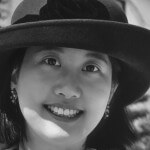 Karen An-hwei Lee is the author of the novels Sonata in K, The Maze of Transparencies, and Love Chronicles of the Octopodes, all published by Eugene Lim, avant-garde editor extraordinaire of Ellipsis Press. Her recent poetry collections are The Beautiful Immunity (Tupelo Press 2024) and Duress (Cascade Books 2022). Her writing has appeared in Yale Review, Iowa Review, Michigan Quarterly, Kenyon Review, Poetry Northwest, Washington Square Review, Image: Art, Faith, Mystery, and anthologized in Best Spiritual Writing and Pearson’s Literature: An Introduction to Fiction, Poetry, Drama, and Writing (14th Edition, ed. by X.J. Kennedy and Dana Gioia). Lee has received a National Endowment for the Arts Fellowship, the Glenna Luschei Award from Prairie Schooner, and the Norma Farber First Book Award from the Poetry Society of America for In Medias Res (Sarabande 2004). She divides her time between the coastal desert of San Diego and the cold winters of Chicago.

Prose
My Voice Will Not Be My Own
Vincenzo della Malva
Requiem for the Golden City
Molara Wood
Clotheslines
Khalil AbuSharekh
An Impasse
Ian MacClayn
Xiaolongbao, My Love
Karen An-hwei Lee
Tabs
Austin Adams
The Blue Plastic Basin
Eric T. Racher
Excerpt from The Confusion of Figure and Ground
Mary Burger
Black Man’s Guide to Bookselling / Snap Shot #46
Jerry Thompson
Selected Dates (1998)
Shawna Yang Ryan
The Temperance of Heretics
Steve Barbaro
Poetry
Mooring
Kirsten Kaschock
Report to Marianne
Mark J. Mitchell
Ode to Sending Light
Mehrnoosh Torbatnejad
People in free situations.
The maintenance manager
DS Maolalai
Cover Art
NYC Skyscraper 2024
Cliff Tisdell